Cycling the walls of Angkor Thom
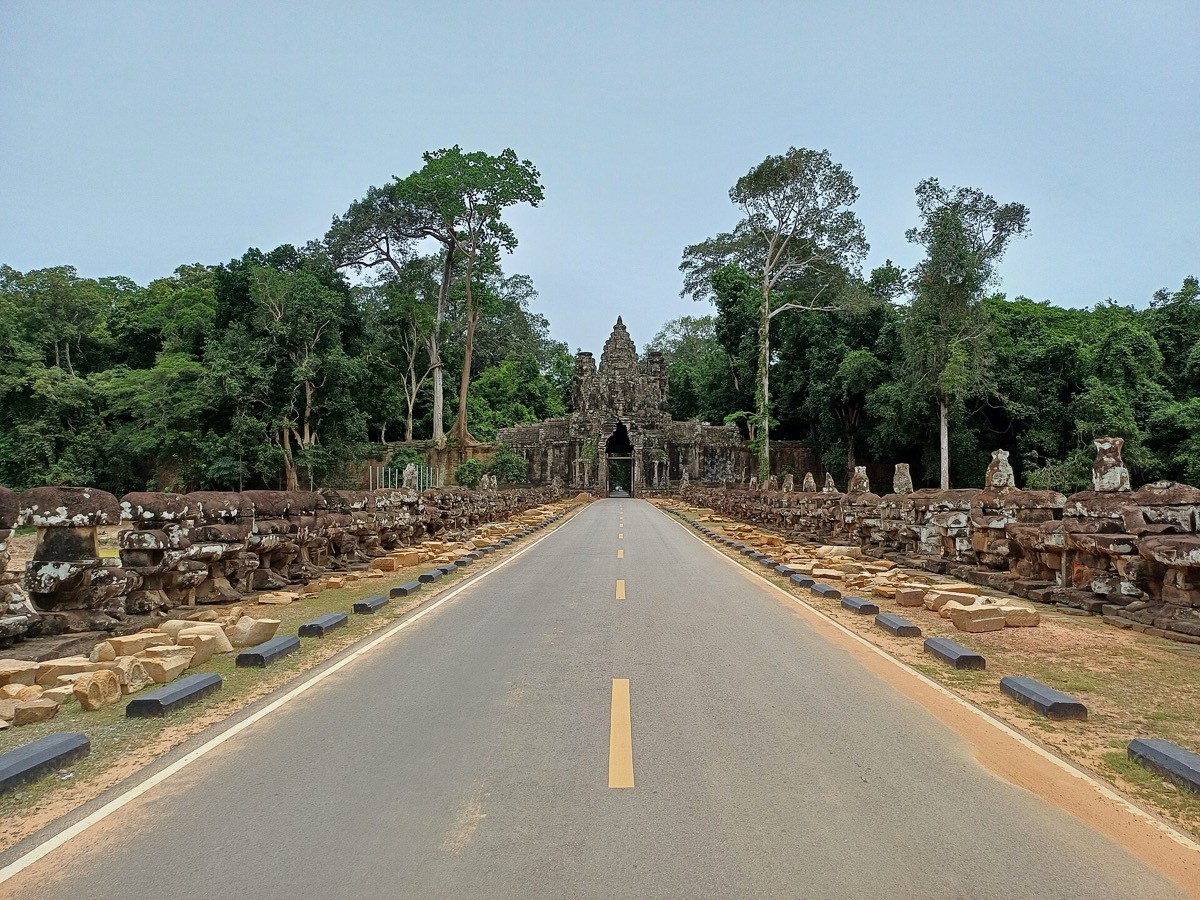
Ride the shaded earth path on top of the old city walls, past forgotten corner temples, five monumental gates and the slow green moat.

- Area
- Angkor core
- Start from
- Angkor Thom South Gate
- Distance
- about 12 km around the walls, plus 16 km from town and back
- Time needed
- half a day
- Best season
- November – February; early morning
- Difficulty
- Moderate
- Transport
- Bicycle or mountain bike
- Tickets & rules
- Angkor Pass
Why go
This is the route I would recommend to anyone who wants to feel the scale of Angkor rather than tick off its highlights. The walls of Angkor Thom form a square three kilometres on each side, and on the inside there is a broad earthen embankment, shaded by tall trees, with a dirt path running along the top. You can ride the whole circuit in an hour or two, and you will likely see more butterflies than people.
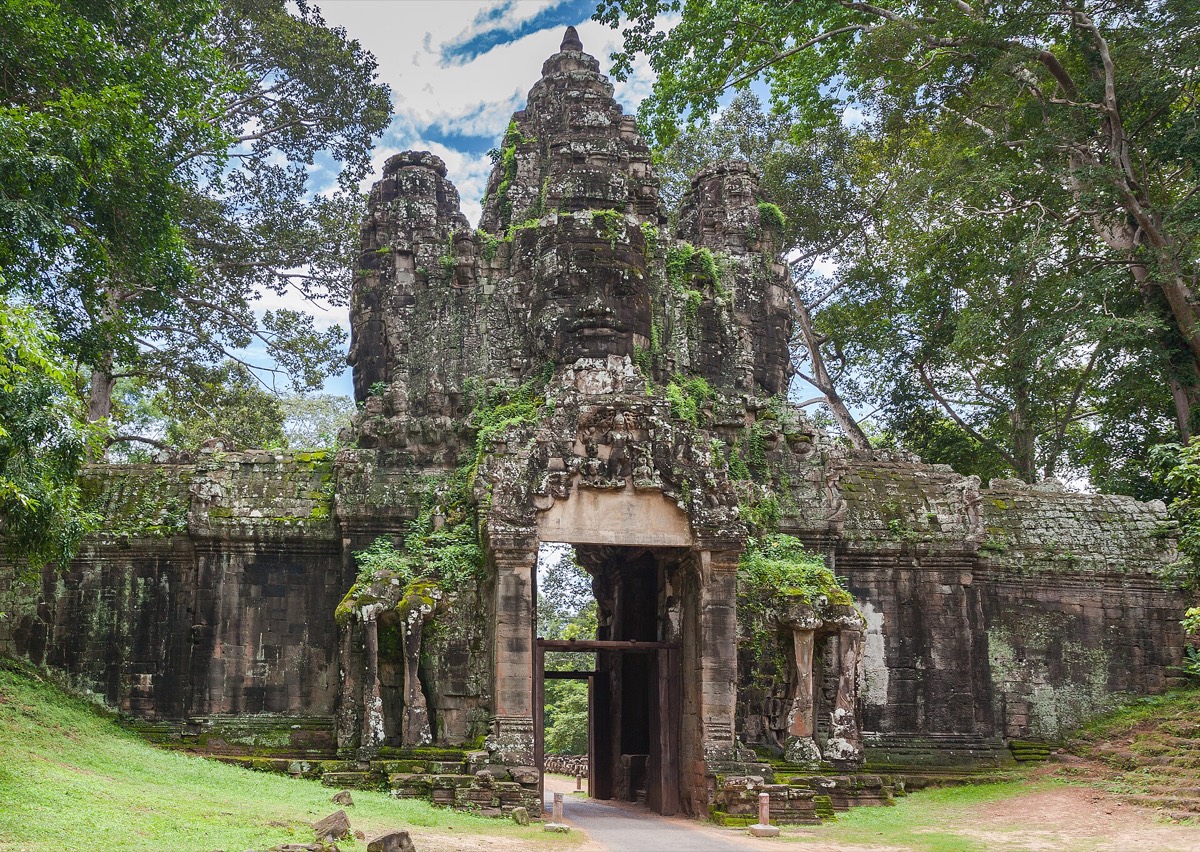
On the way you pass all five gates, each crowned with four giant faces, and at every corner a small temple called Prasat Chrung, where carved inscriptions celebrate the founding of the city. Below, the moat is full of water lilies and, in the morning, villagers fishing with nets.
It is also a good antidote to temple fatigue. The ride is mostly in the forest, with the city’s ruins somewhere off to one side, and you feel like an explorer rather than a tourist.
The story
Jayavarman VII built the walls of Angkor Thom at the end of the twelfth century, after the Cham sacked the previous capital in 1177. Eight metres high and made of laterite, they enclosed an area of about nine square kilometres. The moat outside was around a hundred metres wide and fed by the rivers and reservoirs that made Angkor an engineering marvel.
There are five gates. Four point to the cardinal directions, and the fifth, the Victory Gate, leads from the royal palace east towards the East Baray. A road from the Victory Gate also led to the Gate of the Dead, though the name is probably a later invention. Each gate was originally closed with wooden doors, and Zhou Daguan noted that they were shut at night and that dogs and convicts with severed toes were not allowed to enter.
The four Prasat Chrung, corner shrines, each held a stele with an inscription praising the king and describing the city as a bride, the walls as her jewels and the moat as the sea. Modern research using lidar, a form of laser scanning from the air, has shown that the area inside the walls was densely laid out with streets, canals and ponds.

Getting there
Rent a bicycle in town for a few dollars a day; many guesthouses have them. Ride the eight kilometres to the South Gate, then climb up onto the embankment on the inside of the wall, just to the left or right of the gate.
The path is unpaved, rooty and sandy in places, so a mountain bike is more comfortable than a city bike. You can leave the embankment at any gate and return to the main road.
A suggested plan
- 6:30Leave town and ride to the South Gate.
- 7:00Climb onto the embankment and ride clockwise, stopping at the south-west corner temple.
- 8:00West Gate: the quietest of all, deep in the forest.
- 8:45North Gate, then the north-east corner and the Gate of the Dead.
- 9:30Exit through the Victory Gate and roll down to the Bayon or Ta Prohm for a rest.
Where to stay
Stay in town. A guesthouse that rents good bicycles saves time in the morning.
Good to know
- Download an offline map before you go; the path is easy to follow but the side tracks can confuse.
- Bring plenty of water; there are no stalls on the walls.
- The West Gate is the least visited and atmospheric with morning mist.
- Go clockwise in the morning so the sun is mostly behind or beside you.
- Roots and sand can unseat you; ride slowly.
- Snakes are rarely seen, but watch where you step in long grass.
- Leave the walls before the midday heat; the forest gets humid and still.