The smiling faces of the Bayon
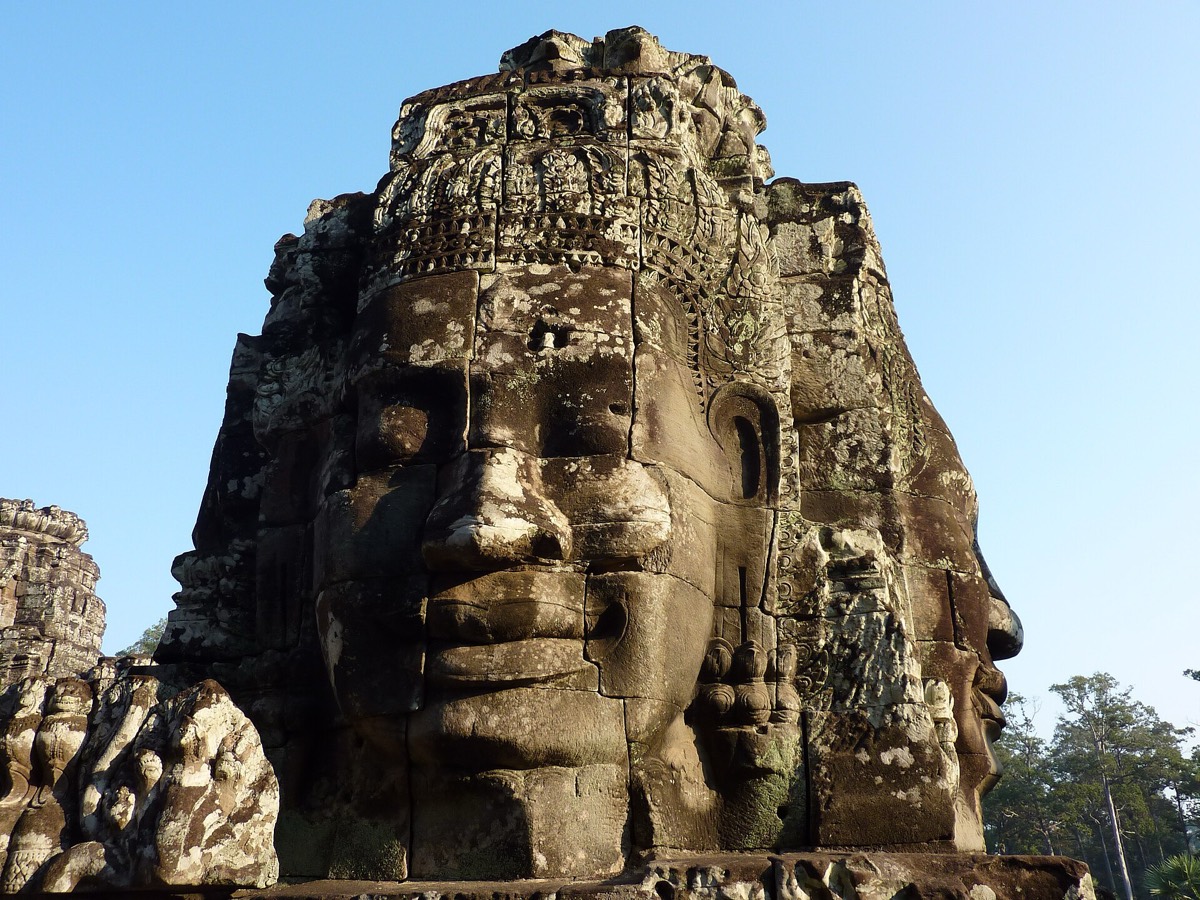
Pass through a gate guarded by stone giants and into a forest of towers carved with more than two hundred serene, enigmatic faces.

- Area
- Angkor core
- Start from
- Angkor Thom South Gate
- Distance
- about 8 km from town
- Time needed
- half a day
- Best season
- All year; early morning or late afternoon
- Difficulty
- Easy
- Transport
- Tuk-tuk, bicycle or e-bike
- Tickets & rules
- Angkor Pass; covered shoulders and knees
Why go
If Angkor Wat is grand and orderly, the Bayon is a dream. You climb into a cramped jumble of towers and passages, and wherever you turn, a huge face looks back at you: calm, half-smiling, eyes lowered. There are faces on every side of every tower, at every height, and as the light moves through the day they seem to change mood, from stern at noon to soft and almost amused in the late afternoon.
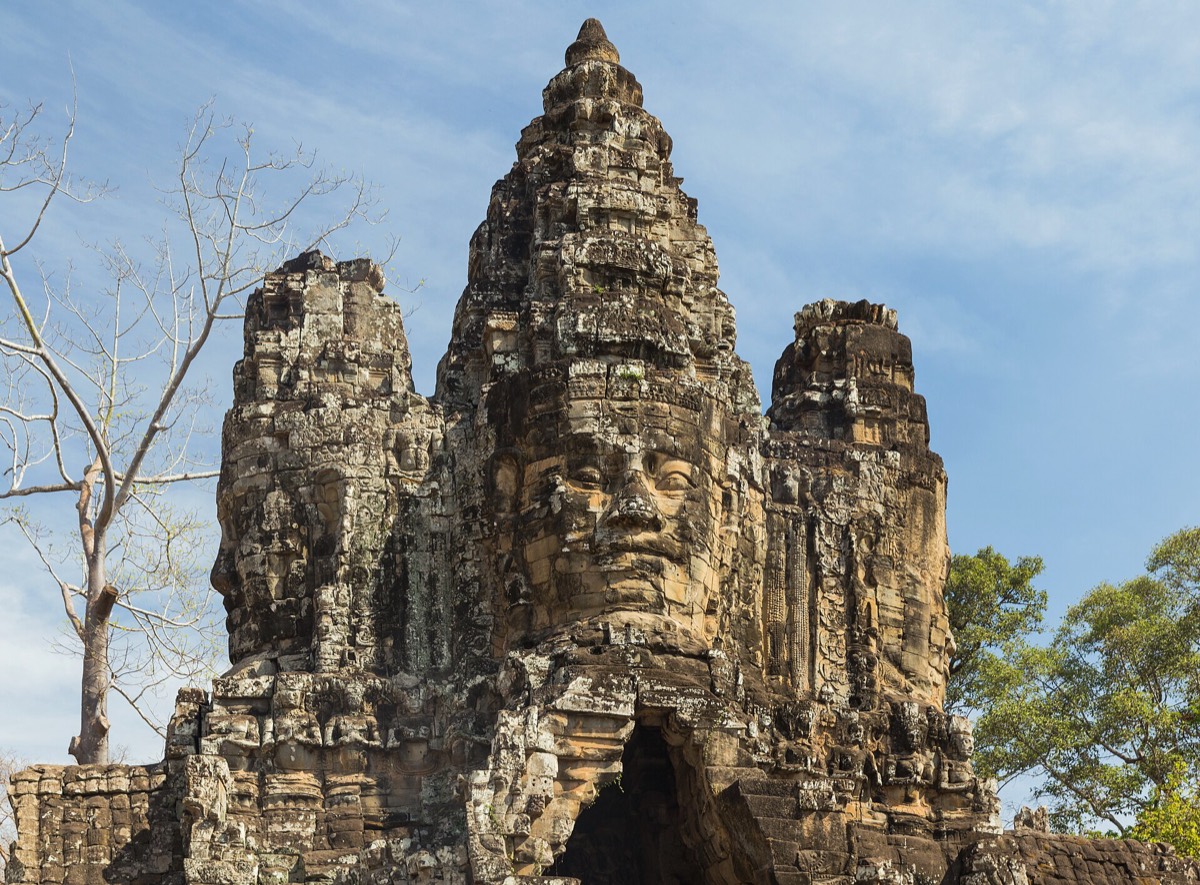
The approach is part of the pleasure. The South Gate of Angkor Thom is a twenty-metre tower crowned with four faces, reached by a causeway lined with rows of stone gods and demons hauling on giant serpents. Riding through it on a bicycle, ducking under the arch as tuk-tuks hoot and monkeys wander along the balustrades, is one of my favourite small moments in Cambodia.
Down at ground level, the outer galleries hold some of the most lively carving at Angkor. Alongside the battles there are scenes of everyday life: market women, cockfights, a man grilling fish, a woman giving birth, a turtle biting a soldier’s bottom.
The story
Angkor Thom, the Great City, was the last and most enduring capital of the Khmer empire. It was built by King Jayavarman VII after he drove out an invading Cham army in the late twelfth century. A devout Mahayana Buddhist, he enclosed his city in a square of laterite walls three kilometres on each side and eight metres high, surrounded by a moat, and placed the Bayon at its exact centre.
The Bayon was built around 1200 and originally had more than fifty towers; around forty survive. Who the faces represent is still debated. Many scholars see them as the bodhisattva Avalokiteshvara, the embodiment of compassion, while others think they bear the features of Jayavarman VII himself, watching over his kingdom in every direction. Quite possibly they were meant to be both.
Much of what we know about life at the time comes from the Chinese envoy Zhou Daguan, who lived here in 1296 and 1297 and wrote a vivid account of the city: its golden towers, its royal processions, its markets run by women, and its bathing habits. Reading him on the spot, it is easy to imagine the streets full of people and the Bayon glinting with gilding.
After Jayavarman VII’s death, later Hindu kings recarved parts of the temple, and Buddha images were chiselled out of niches, but the faces were left in place. Restoration teams from Japan and other countries have been working on the Bayon for decades.

Getting there
From town, follow the main road past Angkor Wat to the South Gate, about eight kilometres in all. The Bayon is a further 1.5 kilometres inside the walls. Tuk-tuk drivers typically combine it with Angkor Wat and Ta Prohm in what is called the small circuit.
Cycling is easy and pleasant here: the roads are flat, shaded in places, and the speed means you can stop for every gate and carving.
A suggested plan
- 7:30Arrive at the South Gate and walk the causeway, looking at the faces of the gods on one side and demons on the other.
- 8:00 – 8:45Walk the outer gallery of the Bayon, especially the eastern and southern walls with the scenes of the Cham war and daily life.
- 8:45 – 10:00Climb to the upper terrace and wander slowly among the face towers.
- 10:00Continue on foot to the Baphuon and the royal terraces just to the north.
- Late afternoonIf you can, come back around 16:00 to see the faces in warm side light with fewer people.
Where to stay
Stay in town; there is nowhere to sleep inside the park. A base near the road to Angkor, north of the old market, saves a few minutes each morning.
Good to know
- The faces photograph best in the morning from the east and in the late afternoon from the west.
- The upper terrace is narrow, so let tour groups pass and wait a few minutes for quiet.
- Look for the little apsaras dancing on lotus flowers on the pillars of the inner galleries.
- There are food stalls and toilets on the north side of the Bayon.
- Macaques around the South Gate are used to being fed and can snatch bags and bottles; do not feed them.
- Steps on the upper terrace are worn and steep; take care in wet weather.
- Children selling postcards may follow you around; buying from them keeps them out of school, so it is kinder to decline gently.