Srah Srang, Banteay Kdei and Ta Keo
A quiet alternative sunrise over a royal bathing pool, a crumbling monastery full of carved dancers, and an unfinished temple-mountain that was never decorated.

- Area
- Angkor core
- Start from
- Siem Reap town
- Distance
- about 12 km from town
- Time needed
- half a day
- Best season
- November – March for sunrise over the water
- Difficulty
- Easy
- Transport
- Tuk-tuk or bicycle
- Tickets & rules
- Angkor Pass; covered shoulders and knees
Why go
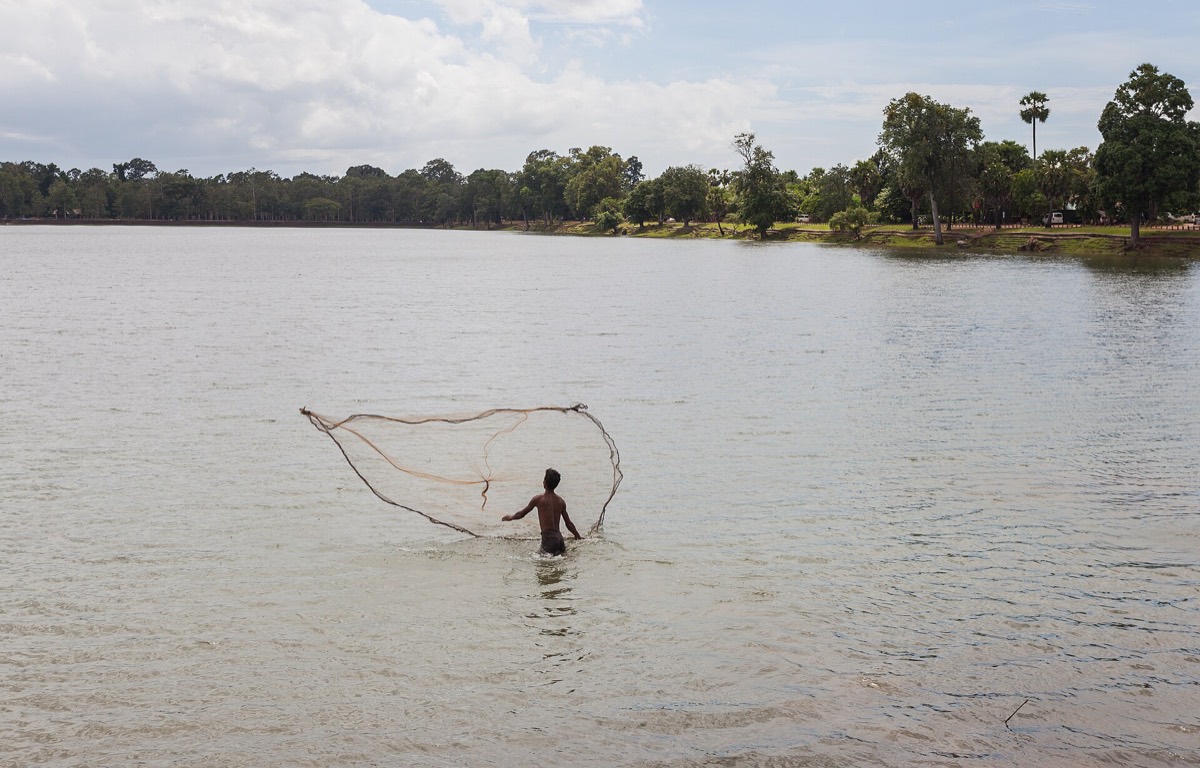
When I wanted sunrise without the crowds at Angkor Wat, I came to Srah Srang. It is a great rectangular reservoir edged with a sandstone landing stage guarded by lions and nagas, and in the dry season the sun comes up behind a small island in the middle. Usually there were only a dozen people, a few fishermen, and children leading water buffalo along the bank.
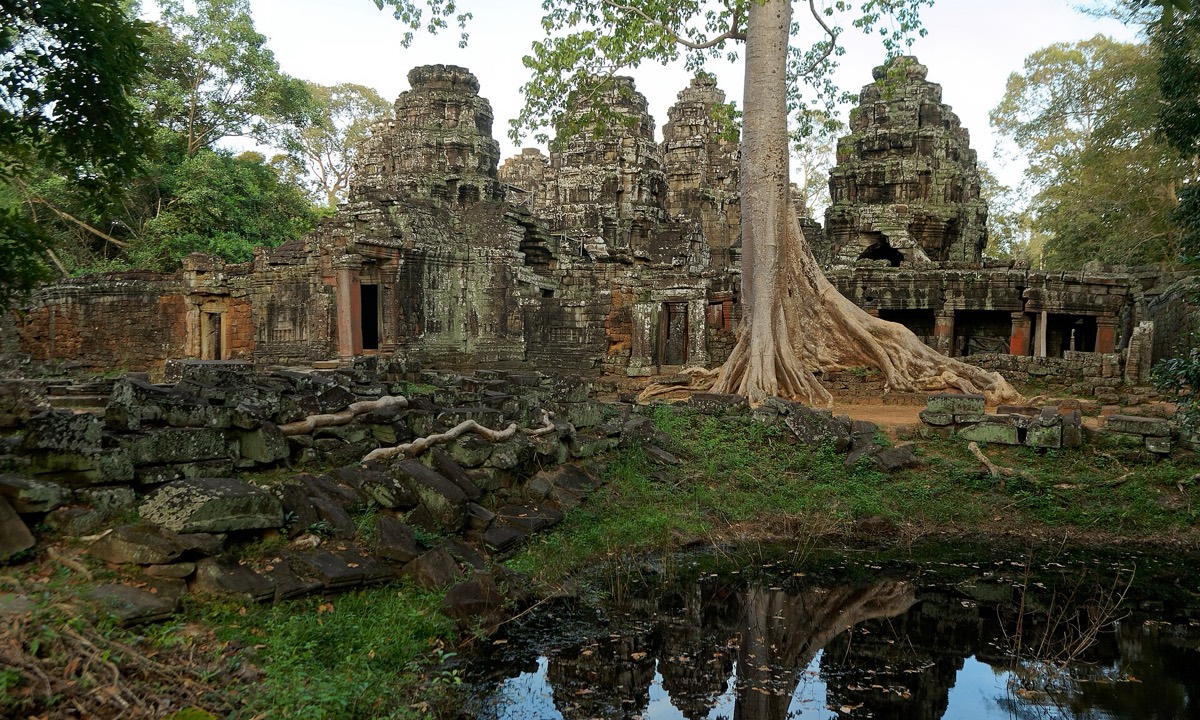
Across the road, Banteay Kdei feels like a gentler, less crowded version of Ta Prohm: long corridors, collapsing towers, carved devatas in the walls and a few large trees. Its Hall of Dancers has pillars covered with apsaras, and there is usually time to sit in a doorway and listen to the birds.
Ta Keo is the opposite in mood. A towering pyramid of bare greenish sandstone, it is completely plain, as if waiting for the carvers to arrive. Climbing it is hard work, and the top is wonderfully quiet.
The story
Srah Srang, the royal bath, was dug in the tenth century and later reworked under Jayavarman VII, who added the elegant landing stage. An inscription found here says that it was reserved for the king and his consorts, and forbade elephants from going in to trample the banks. Today children swim in it in the heat and fishermen cast nets at dusk.
Banteay Kdei, the citadel of cells, was built in the late twelfth and early thirteenth century, mostly in the style of the Bayon. In 2001 a team from a Japanese university uncovered a pit near the temple containing more than two hundred Buddha statues, many decapitated, which had been buried in antiquity, probably when a Hindu king turned against Buddhism. It was one of the most important finds at Angkor in decades.
Ta Keo was begun around the year 1000 as the state temple of Jayavarman V and stands more than twenty metres tall on five tiers. The work stopped, and no one knows for sure why: an inscription mentions that lightning struck the temple, a bad omen, while other theories point to the king’s death and the political turmoil that followed. Because the hard sandstone was never carved, it gives you a rare chance to see how Khmer builders laid their blocks before the decoration began.

Getting there
Srah Srang is about four kilometres east of Angkor Wat on the small circuit. Ask your tuk-tuk to go there for sunrise, then continue to Banteay Kdei across the road, Ta Prohm next door and Ta Keo a little further on.
By bicycle this is a comfortable loop of around twenty-five kilometres from town and back.
A suggested plan
- 5:15Leave town in the dark and settle on the landing stage at Srah Srang.
- 6:30Have noodle soup or coffee at the stalls opposite the pool.
- 7:00 – 8:15Walk through Banteay Kdei from east to west, pausing in the Hall of Dancers.
- 8:30 – 9:15Visit Ta Prohm, a few minutes away, before the tour groups arrive.
- 9:30 – 10:15End at Ta Keo and climb the steep stairs to the top platform.
Where to stay
Any base in town works. Wat Bo and Sala Kamreuk lanes on the east side of the river are handy for the early start.
Good to know
- Srah Srang is also lovely at sunset, when the stone lions glow and kids swim.
- The stalls by Srah Srang serve simple breakfasts; agree prices before you sit.
- At Banteay Kdei, look for the carved devatas with tall headdresses on the inner walls.
- Ta Keo’s stairs are steep with shallow treads; climbing diagonally helps.
- The landing stage at Srah Srang is uneven and can be slippery at dawn.
- Stalls may try to steer you to a table with high prices; you are free to walk on.
- Do not climb Ta Keo in heavy rain; the stairs are exposed.