Angkor Wat at sunrise
Watch the five towers of the world’s largest religious monument appear out of the dark, then wander its galleries while most visitors go back for breakfast.

- Area
- Angkor core
- Start from
- Siem Reap town
- Distance
- about 7 km from town
- Time needed
- half a day
- Best season
- November – March for clear skies; the equinoxes for the sun over the central tower
- Difficulty
- Easy
- Transport
- Tuk-tuk hired the evening before, bicycle or e-bike
- Tickets & rules
- Angkor Pass (1, 3 or 7 days); shoulders and knees covered; the upper Bakan level has its own dress check and closes on Buddhist holy days
Why go
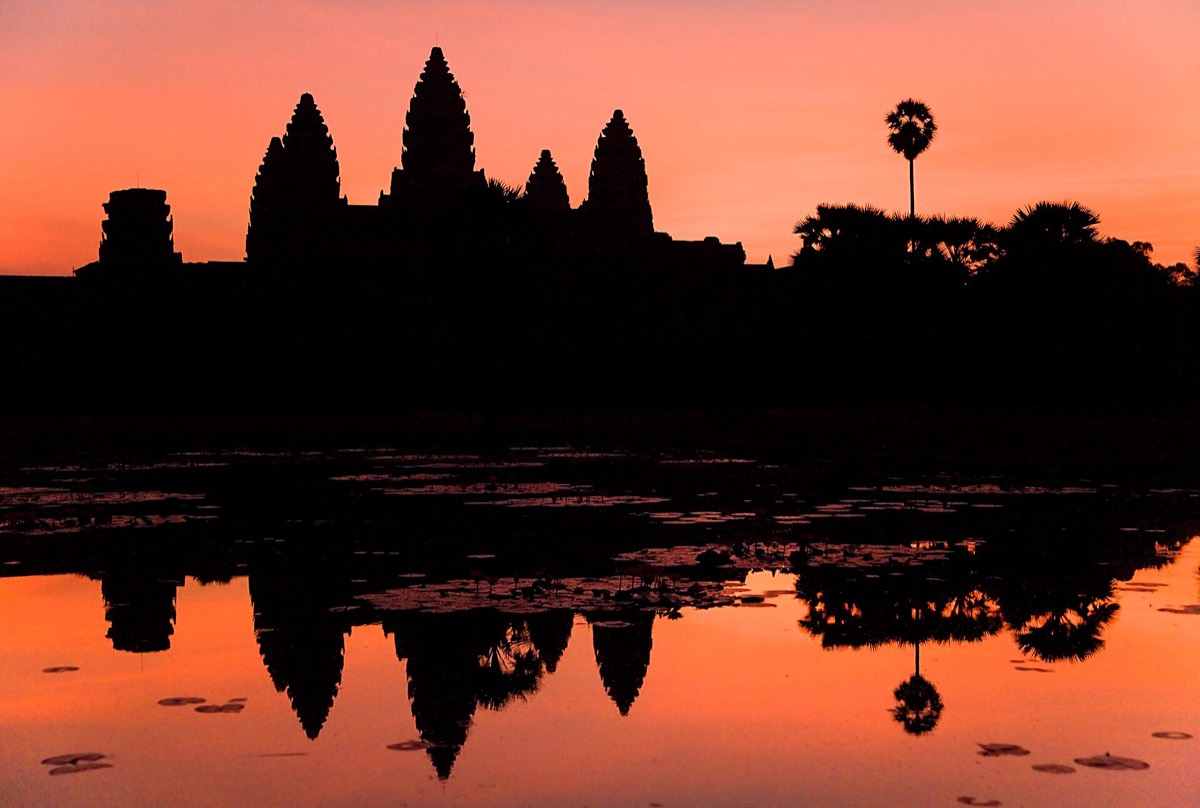
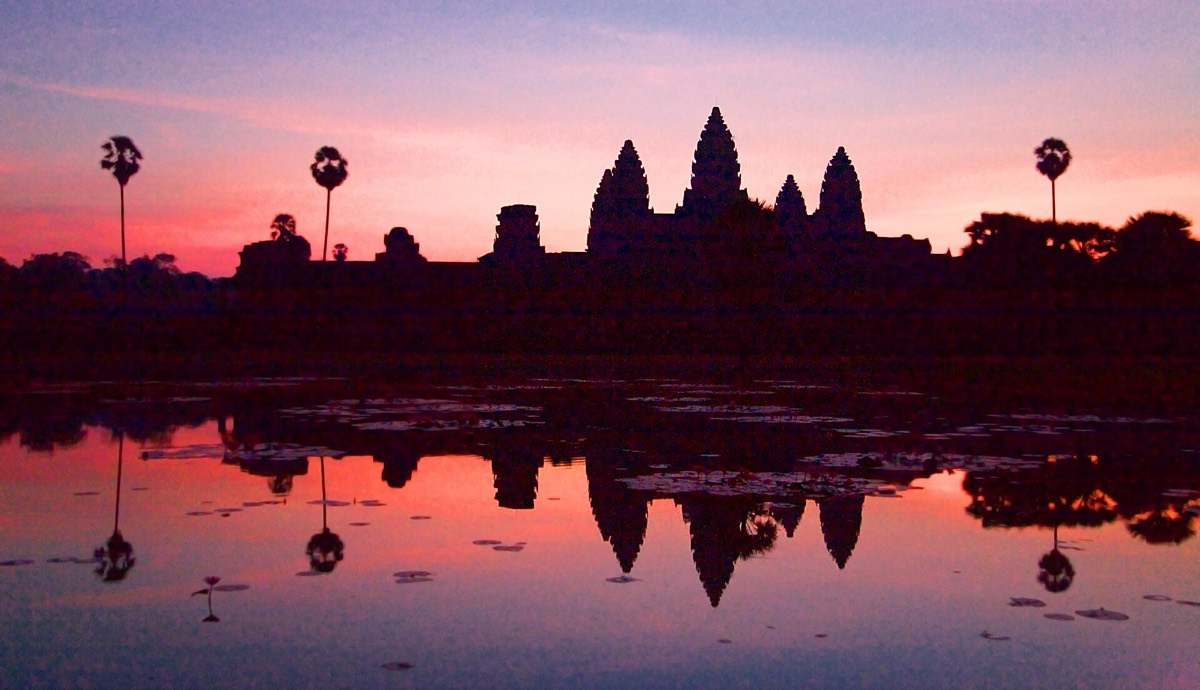
There is a reason everybody does this, and I stopped feeling sheepish about it the moment I sat down by the northern reflecting pool at five in the morning. First there is nothing, just frogs and a few hundred whispering people. Then the sky turns violet, the silhouette of the five lotus-bud towers sharpens against it, and the water doubles everything. It is theatrical in the best possible way, and no photograph quite prepares you for the scale.
The real secret, though, is what comes after. Around seven o’clock most of the sunrise crowd heads back to their hotels for breakfast, and the temple empties. That is the hour to walk the long galleries of bas-reliefs, to climb into the cool inner courtyards, and to watch monks in saffron robes cross the causeway in the low gold light.
Angkor Wat rewards slowness. It is not a single building so much as a carefully built model of the universe, and the longer you stay the more it reveals: a carved apsara with an unusual smile, a lintel half eaten by lichen, a window of stone balusters throwing striped shadows across the floor.
The story
Angkor Wat was built in the first half of the twelfth century under King Suryavarman II and dedicated to the Hindu god Vishnu. Unusually for Khmer temples, it faces west, the direction associated with death, which has led many scholars to believe it was also intended as the king’s funerary temple. The construction took decades and involved tens of thousands of workers, and the sandstone was floated and hauled from the quarries of Phnom Kulen, some fifty kilometres away, along a network of canals.
The layout is a map of the Hindu cosmos. The moat, nearly two hundred metres wide, represents the ocean around the world; the concentric galleries are the mountain ranges; and the central tower is Mount Meru, home of the gods. The whole enclosure measures roughly 1.5 by 1.3 kilometres, and walking around the outer moat alone takes well over an hour.
The bas-reliefs in the outer gallery run for hundreds of metres and are among the finest stone carving anywhere. On the eastern side is the Churning of the Ocean of Milk, where gods and demons pull on a giant serpent to stir up the elixir of immortality. On the southern side, Suryavarman II himself parades with his army, shaded by fifteen parasols, alongside a vivid panel of heavens and hells.
Unlike most of Angkor, the temple was never fully abandoned. By the sixteenth century it had become a Theravada Buddhist shrine, pilgrims came from across the region, and a Japanese visitor in 1632 left an ink inscription that can still be seen. Today it appears on the Cambodian flag, the only building to feature on a national flag in this way.

Getting there
Buy your Angkor Pass beforehand at the official ticket centre on the road between town and the temples, or online through the official site; the ticket centre opens before dawn, but the queue is shorter the afternoon before. A tuk-tuk for sunrise and the morning usually costs somewhere around fifteen to twenty dollars; agree the price and the pick-up time the night before.
By bicycle the ride takes about half an hour on flat roads, but the road is dark before dawn, so bring a front light and wear something bright.
A suggested plan
- 4:45Leave town in the dark; the main gate to the causeway opens at around five.
- 5:15 – 6:30Sit on the steps by the northern (left-hand) reflecting pool and watch the sky change.
- 6:30 – 8:30Walk the outer gallery of bas-reliefs clockwise, starting with the Churning of the Ocean of Milk on the east side.
- 8:30 – 9:30Climb to the Bakan, the upper level, if it is open, and look out over the forest.
- 9:30Leave by the quieter east gate and have breakfast at one of the stalls near the moat, or ride on to Angkor Thom.
Where to stay
Any guesthouse in town works, since the temple is only a short ride away. The lanes around Wat Bo and the quieter streets east of the river are calm, walkable to dinner, and close to the road north to the temples.
Good to know
- Bring a torch for the causeway before dawn; the paving stones are uneven.
- Coffee sellers wander through the crowd at sunrise, so you do not need to bring a flask.
- The equinoxes in March and September line the rising sun up over the central tower, and draw the biggest crowds of the year.
- If the sky is cloudy, stay anyway: soft overcast light is wonderful for the bas-reliefs.
- Carry your pass at all times; it is checked at most temples and has your photo printed on it.
- The steep stairs to the Bakan are railed, but still treat them carefully, especially going down.
- Persistent vendors near the causeway can be firm; a smile and a clear no thank you are enough.
- Be respectful of people praying at the shrines inside; do not climb on carvings or sit on altars.