Wat Phnom and the Legend of Lady Penh
A small wooded hill with a stupa and a busy shrine, the place where, legend says, the city of Phnom Penh began.

- Area
- Royal riverside
- Start from
- Central Phnom Penh
- Distance
- walking distance, north of the riverside
- Time needed
- 1–2 hours
- Best season
- All year; early morning or late afternoon
- Difficulty
- Easy
- Transport
- On foot or tuk-tuk
- Tickets & rules
- Small entry fee for foreign visitors (around 1 USD); modest dress in the temple
Why go
Phnom means hill, and Phnom Penh means the Hill of Penh. The hill in question is this one: a modest wooded mound, about twenty-seven metres high, crowned by a white stupa and a temple. It is the only real height in the old city, and it gives the capital its name, its founding legend and its favourite shrine.
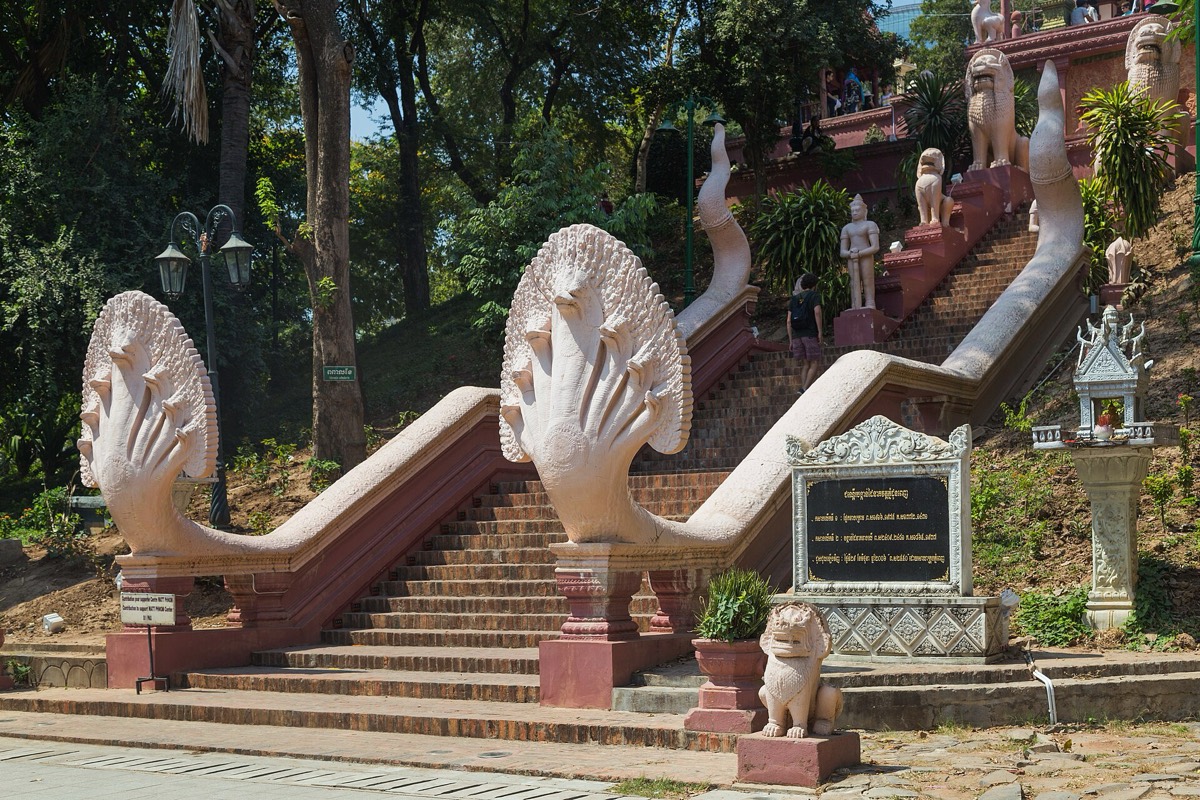
Climb the staircase guarded by long naga balustrades and stone lions, and you come up into a temple that is never quiet. People come to pray for exams, good business, a baby or a lottery win. Fortune tellers sit in the shade, women sell lotus buds and jasmine garlands, and caged birds are offered to be released for merit. The air smells of incense and hot stone.
It is a short visit, but it shows something you don’t see in grander places: how Phnom Penh people actually pray. I like it best in the late afternoon, when office workers drop in on the way home and the long light comes through the trees.
The story
The legend goes like this. In 1372 a wealthy widow called Daun Penh, Grandmother Penh, saw a great koki tree floating down the flooded river. When she pulled it ashore she found inside it four bronze Buddha images and a stone figure of Vishnu. She had the people raise a hill and built a small shrine on top to house them, and the settlement around it came to be called Phnom Daun Penh.
Behind the main temple a little shrine to Lady Penh herself sits on the slope, with a statue of a kind, smiling old woman. It is one of the most visited spots on the hill, especially by women. Elsewhere you will find a shrine to the guardian spirit Preah Chau, and images of Chinese deities, a reminder of how Buddhist, Brahmanic and folk traditions overlap in everyday Khmer life.
The large stupa behind the temple is said to hold the ashes of King Ponhea Yat, who moved the Khmer capital to this area in the fifteenth century after Angkor was abandoned. On the roundabout at the base of the hill, look for the enormous clock face planted in flowers, a favourite backdrop for photos.
The temple has been rebuilt several times, most recently in the twentieth century, but the hill has kept its role as the symbolic centre of the city all along.

Getting there
Wat Phnom is at the northern end of Norodom Boulevard, about a fifteen-minute walk north from the busy part of the riverside. Tuk-tuk drivers know it simply as Wat Phnom.
The ticket booth is at the foot of the main staircase on the east side.
A suggested plan
- ApproachWalk up from the riverside along Sisowath Quay or past the old French post office.
- ClimbTake the eastern naga staircase to the temple; remove shoes before entering the sanctuary.
- Around the topVisit the stupa, the Lady Penh shrine and the small spirit shrines; watch, don’t intrude.
- BelowWalk the shady park around the base, and look at the colonial buildings nearby.
- ContinueHead on to the riverside or the Central Market by tuk-tuk.
Where to stay
The streets just north of the riverside, around the old post office and the area once known as the French Quarter, are quieter than the main strip and close to the hill.
Good to know
- Small notes are useful for offerings and the entry fee.
- If you buy jasmine or lotus, place it at the altar rather than handing it to monks.
- Late afternoon is the most atmospheric time.
- Wear clothes that cover your shoulders and knees.
- Bird sellers may press you to release a sparrow for merit; it is a personal choice, but many birds are recaptured.
- Children selling small things can be persistent; a polite smile and no is enough.
- Keep a hand on your bag in the busy park around the base.