The Royal Palace and the Silver Pagoda
Golden spires, frangipani courtyards and a temple floored with thousands of silver tiles, at the ceremonial heart of the Cambodian kingdom.

- Area
- Royal riverside
- Start from
- Sisowath Quay, central Phnom Penh
- Distance
- walking distance from the riverside
- Time needed
- half a day
- Best season
- November – February is coolest; go at opening time all year
- Difficulty
- Easy
- Transport
- On foot from the riverside, or tuk-tuk / ride-hailing app
- Tickets & rules
- Entry ticket (roughly 10 USD, check current price); shoulders and knees must be covered; closed for a long lunch break
Why go
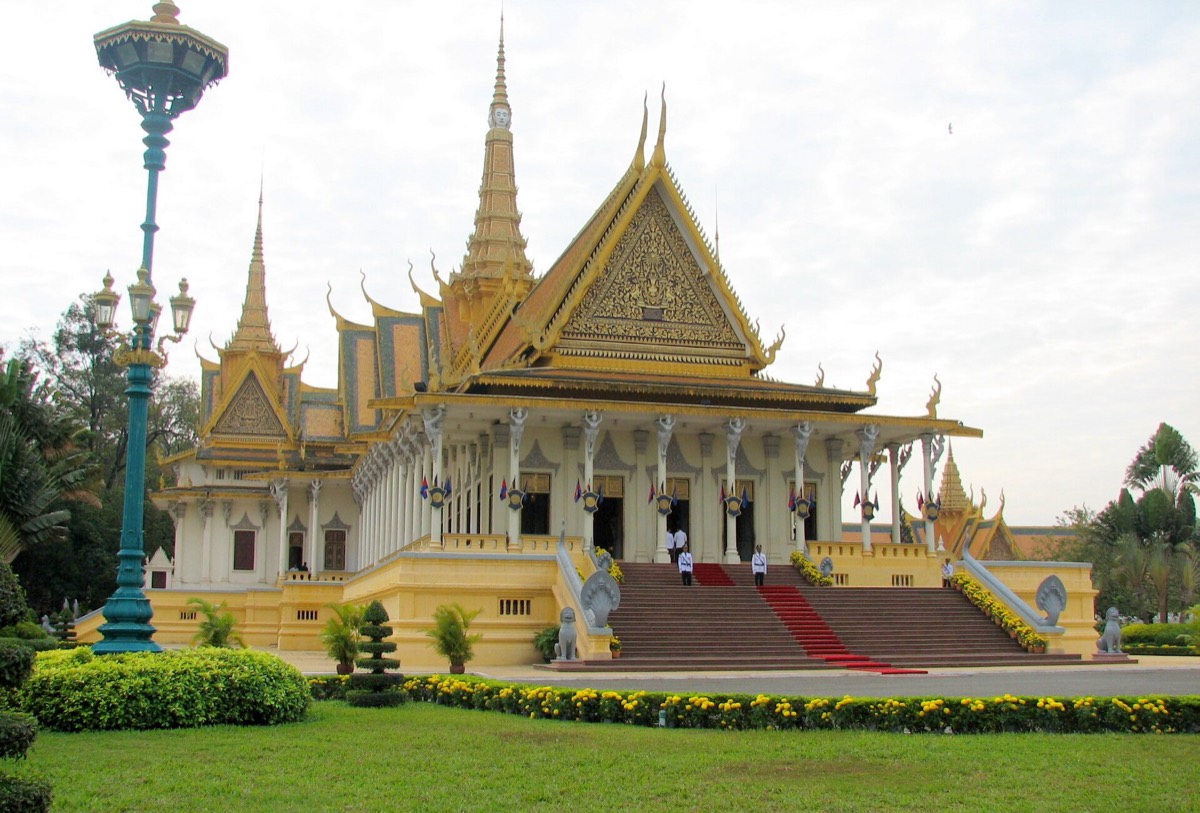
Behind the long yellow walls on the riverfront lies the most graceful corner of the city. The Royal Palace compound is still the residence of the King, so parts of it are closed, but what is open is enough to fill a slow morning: the soaring Throne Hall with its tiered roofs and naga-tipped gables, pavilions where royal dancers once rehearsed, and lawns kept as neatly as a botanical garden. Everything is in saffron, white and gold, and against a blue November sky it looks almost unreal.
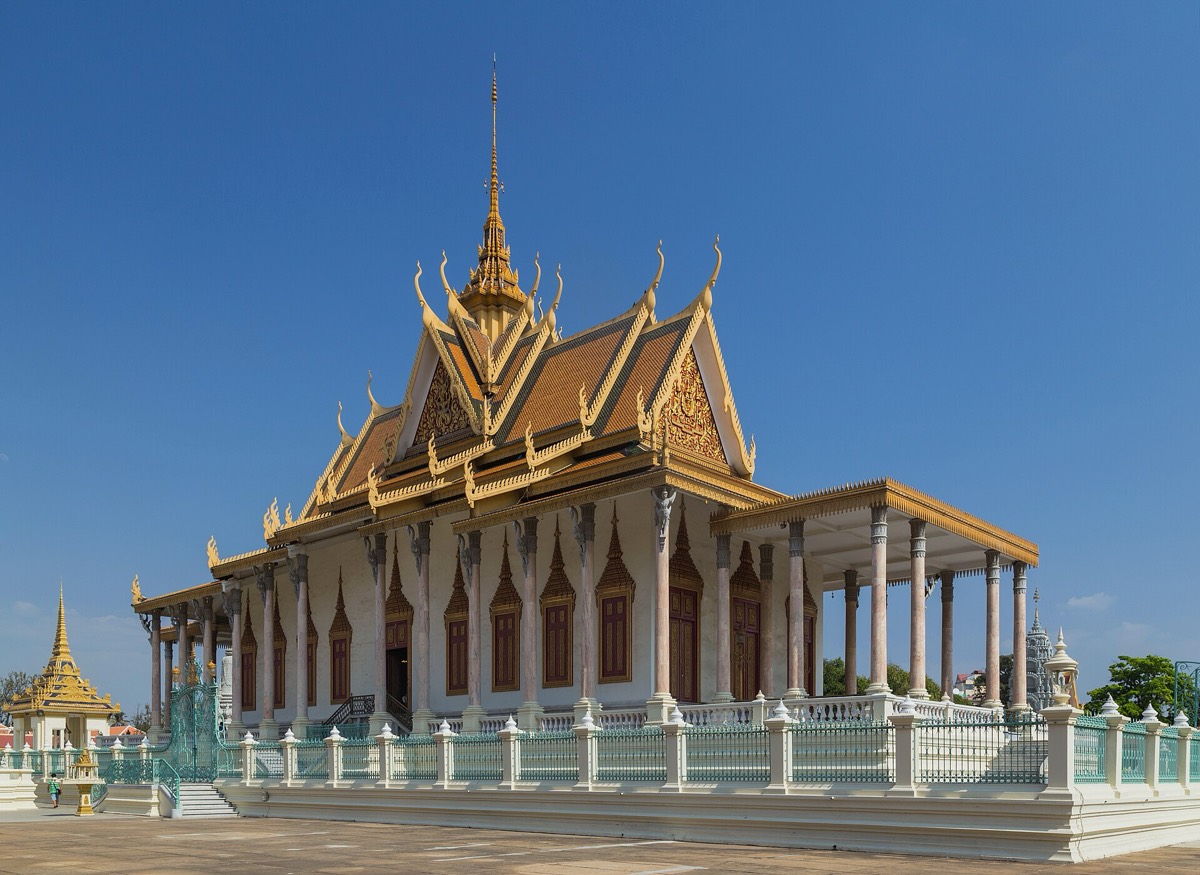
Through a gate to the south lies the Silver Pagoda, properly Wat Preah Keo Morakot, the Temple of the Emerald Buddha. Its floor is laid with more than five thousand silver tiles, each said to weigh around a kilogram. Most are covered by carpets to protect them, but a few are left bare near the entrance, and the dull gleam is strangely moving. On the dais sits a small, luminous green Buddha, and below it a life-size gold Buddha studded with thousands of diamonds.
I love the cloister around the pagoda just as much. Its walls carry a long painted mural of the Reamker, the Khmer telling of the Ramayana: monkey armies, demon kings, flying chariots and palace intrigues, faded and flaking in places, best followed slowly with the sun moving across it.
The story
Phnom Penh became the permanent royal capital only in the 1860s. For more than two centuries before that the court lived at Oudong, a ridge of stupas to the north. King Norodom moved his capital to the confluence of the rivers in 1866, partly for its trade and partly under the influence of the French protectorate, and the palace grew up over the following decades. The present Throne Hall was completed in 1919, replacing an earlier wooden one.
The Silver Pagoda was first built under Norodom in wood and brick and rebuilt in the early twentieth century. The gold Buddha was cast in the reign of King Sisowath from the gold of royal jewellery, according to the usual telling, and weighs around ninety kilograms. During the Khmer Rouge years, when religion was banned and so much else was destroyed, much of the pagoda’s treasure survived, partly because the regime wanted to show foreign visitors that Cambodian heritage was being respected.
Look out for the odd little cast-iron pavilion near the Throne Hall. It is the Napoleon III Pavilion, originally made for the Empress Eugénie for the opening of the Suez Canal in 1869 and later shipped to Phnom Penh as a gift to the Cambodian king. It looks utterly French among the Khmer roofs, a small reminder of how many worlds met at this bend of the river.
Around the pagoda stand stupas holding the ashes of kings and a royal princess, and a small hill representing Mount Kailash with a footprint of the Buddha. Monks and families come to pray here, so the compound is a living place, not only a museum.

Getting there
The entrance for visitors is on Sothearos Boulevard, on the side facing away from the river, not through the grand gates on the riverfront. From most riverside guesthouses it is a ten to fifteen minute walk; otherwise any tuk-tuk driver knows it.
The palace usually opens in the early morning, closes for a long lunch break around the middle of the day and reopens in the afternoon until about five. Hours change around ceremonies and royal events, so check the day before.
A suggested plan
- Opening timeArrive early, buy tickets at the official counter and, if needed, borrow or buy a covering for shoulders or knees.
- First hourThe Throne Hall, the Napoleon III Pavilion and the palace gardens, while the light is soft.
- Second hourThrough to the Silver Pagoda; look for the bare silver tiles, then walk the full Reamker mural in the cloister.
- Late morningLeave before the midday close and walk to the National Museum next door, or to the river for a cold drink.
- EveningReturn to the park in front of the palace at dusk, when families picnic and flags snap in the river wind.
Where to stay
Base yourself along the riverside or in the lanes just south of the palace, around streets 178, 240 and 19. You can walk to the palace, the museum and the river, and the area has quiet small hotels, bakeries and good coffee.
Good to know
- Wear a T-shirt with sleeves and long trousers or a skirt below the knee; vest tops and shorts are turned away.
- Photography is not allowed inside the Silver Pagoda itself, but is fine in the courtyards.
- A licensed guide at the gate adds much to the stories; agree the price first.
- Combine with the National Museum, which is a few minutes’ walk away.
- Ignore anyone outside claiming the palace is closed and offering an alternative tour; check with the ticket office yourself.
- The courtyards reflect a lot of heat by late morning; carry water and a hat.
- Parts of the palace can close without notice for royal ceremonies.