The salt fields between Kampot and the sea
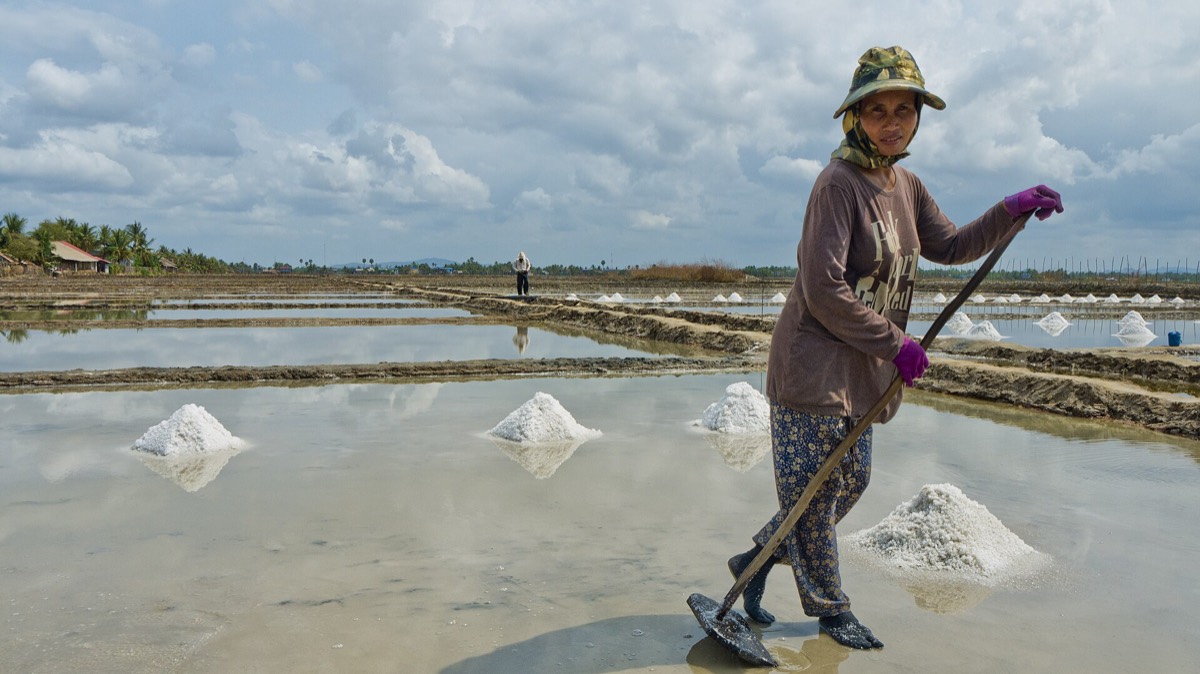
A flat, shining landscape of salt pans and wooden storage barns, where workers rake white crystals in the dry-season heat as they have for generations.

- Area
- Countryside & caves
- Start from
- Kampot
- Distance
- about 5–15 km each way
- Time needed
- half a day
- Best season
- January – May for the salt harvest
- Difficulty
- Easy
- Transport
- Bicycle, scooter or tuk-tuk
- Tickets & rules
- None; ask before photographing workers
Why go
East and south of Kampot, toward Kep, the land flattens into a grid of shallow pans divided by low earth walls. For half the year they are rice paddies or flooded; in the dry season they turn into salt fields, mirrors of seawater evaporating under the sun.
Watching the harvest is fascinating. Workers, many of them women in conical hats and long sleeves, rake the crystals into small white heaps, then carry them in baskets on shoulder poles to long thatched barns. The light at sunrise and sunset, reflected in the pans, is extraordinary.
It is an easy ride from town, combines well with the pepper farms or Phnom Chhnork, and gives you a glimpse of the hard work behind one of the region’s oldest industries.
The story
Kampot and Kep have produced sea salt for centuries, and today the two provinces supply most of Cambodia’s salt. Seawater is let into the outer ponds at high tide and moved inland through a series of smaller pans, getting saltier as the sun evaporates it, until crystals form in the final shallow pans.
The work is seasonal and depends entirely on the weather. A good dry season with strong sun brings a large harvest; an early rainy season can ruin it, and in some years Cambodia has had to import salt. Many workers are local farmers who grow rice in the wet months and work the salt in the dry ones.
The barns where the salt is stored are long, low wooden structures, sometimes on stilts, packed with mounds of grey-white salt. In recent years cooperatives and small producers have also begun harvesting fleur de sel, the delicate crystals that form on the surface, which is sold in little jars in Kampot’s shops.
Climate change and rising seas are a real worry here; changes in rainfall have already affected yields. The fields may look timeless, but the people working them are acutely aware of how fragile it all is.
Getting there
The salt fields begin a few kilometres east of town; follow the main road toward Kep and turn onto the smaller roads on either side. Many tuk-tuk drivers include them in a countryside tour with the pepper farms and caves. By bicycle, they make a pleasant flat loop of two to three hours.
A suggested plan
- 6:00 amLeave town at sunrise to see the pans in the soft light.
- 6:30 amWalk along the earth walls between pans; watch workers raking and carrying salt.
- 7:30 amLook inside a storage barn if invited.
- 8:30 amBreakfast in a roadside village; ride back or continue to Phnom Chhnork.
Where to stay
Kampot is the obvious base, though Kep is also close. Riverside places east of the old bridge are slightly nearer to the fields.
Good to know
- Go early: by 9 am it is blindingly bright and very hot.
- Wear sunglasses and a hat; the reflection off the pans is intense.
- Buy a small jar of Kampot salt or fleur de sel to take home.
- Polite gestures go a long way: smile, ask permission, and don’t get in the way of the work.
- Don’t walk into the pans themselves; stick to the dykes so you don’t damage the crust.
- Sunburn and dehydration are real risks in this open landscape.
- In the rainy season the fields are flooded and there is little to see.