Kilim: mangroves, limestone and eagles
A slow boat through mangrove channels and limestone towers to bat caves, fish farms and a narrow sea passage where eagles wheel overhead.

- Area
- North coast & Kilim
- Start from
- Kilim jetty
- Distance
- boat trip of about 10–20 km along the river
- Time needed
- half a day
- Best season
- All year; calmer November – April
- Difficulty
- Easy
- Transport
- Taxi to Kilim, then a boat
- Tickets & rules
- Boat fee; small entrance fees at the bat cave and some stops
Why go
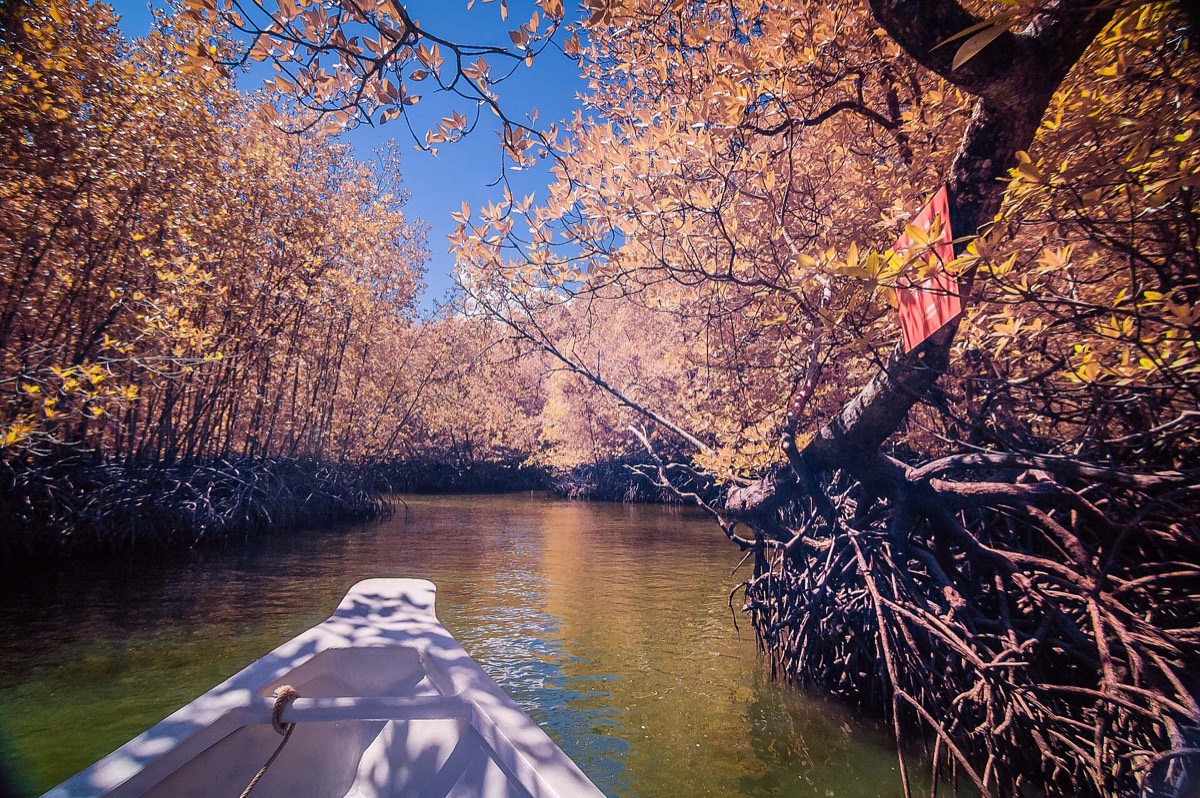
The Kilim Karst Geoforest Park covers the north-east corner of Langkawi, where grey limestone hills rise straight out of mangrove rivers. A boat ride here feels like entering another country: the water is still and green, roots grip the mud on both banks, and towering cliffs close in and then open onto wide estuaries.
Boats stop at Gua Kelawar, the Bat Cave, where a boardwalk leads through the mangrove to a cave full of roosting bats, and pass Gua Buaya, the Crocodile Cave, a low tunnel through the rock that opens onto the sea. There are often stops at a floating fish farm, where you can see groupers, rays and horseshoe crabs.
Above you, Brahminy kites and white-bellied sea eagles circle. In the quiet stretches, if you ask the boatman to cut the engine, you will hear mudskippers flopping on the mud and kingfishers calling from the trees. It is the most memorable half-day on Langkawi for many people.
The story
The limestone at Kilim is much younger than the Machinchang rocks, but still very old, mostly laid down in a tropical sea in the Ordovician to Permian periods. Rain and seawater have carved it into towers, caves and notches over millions of years, and the mangroves grew in the sheltered channels in between.
The name Langkawi is often linked to the eagle: helang in Malay, combined with kawi, a word for a reddish-brown stone or colour. Not everyone agrees on the origin, but the eagle has become the island’s symbol, and Kilim is where you see the most of them.
For years boatmen fed the eagles chicken skin to make them swoop for tourists. Scientists and conservationists have raised concerns about the effect on the birds’ health and behaviour, and some operators now skip or reduce the feeding. You can ask your boatman not to feed them.
The local communities around Kilim were once mainly fishermen and charcoal makers, cutting mangrove wood. Today many families run boats or work at the jetty, and the park is one of the main reasons the Langkawi Geopark keeps its UNESCO status.
Getting there
The Kilim jetty is about 30 minutes by car from Kuah and 45 minutes or more from Pantai Cenang. Many hotels and agencies sell tours with transfers, but you can also turn up at the jetty and hire a boat directly.
Boats are usually priced per boat, not per person, for a set route of two to four hours. Agree on the route, stops and price before you leave.
A suggested plan
- 8–9 amArrive at Kilim jetty and hire a boat before the tour groups.
- MorningCruise through the mangrove channels to the Bat Cave and walk the boardwalk.
- Late morningPass through the Crocodile Cave to the open sea, if the tide allows.
- MiddayStop at the fish farm, then cruise back slowly with the engine low.
- AfternoonLunch near the jetty; consider Tanjung Rhu or the Galeria Perdana nearby.
Where to stay
There are a few resorts in the Kilim and Tanjung Rhu area, quiet and close to the mangroves. Otherwise Kuah is the nearest town base, and Pantai Cenang is fine with a taxi.
Good to know
- Go early or late afternoon for softer light and fewer boats.
- Ask for a smaller boat and a quieter route.
- Bring a hat and sunscreen; boats often have little shade.
- A kayak tour lets you enter smaller channels the engines cannot.
- Avoid tours that push eagle feeding or hold animals for photos.
- Monkeys at the jetty steal bags and drinks.
- Confirm the boat has life jackets for everyone.