Sabah Museum, the city mosque and Likas wetlands
A rainy-day loop through a museum shaped like a Rungus longhouse, a white mosque that seems to float on a lagoon, and a mangrove boardwalk in the middle of the city.

- Area
- Kota Kinabalu
- Start from
- Kota Kinabalu
- Distance
- about 15 km by car in total
- Time needed
- 1 day
- Best season
- All year; ideal on a rainy day
- Difficulty
- Easy
- Transport
- Taxi or ride-hailing between stops
- Tickets & rules
- Museum and wetland centre entry fees; modest dress for mosques, robes lent at the door
Why go
Sabah gets heavy rain, especially in the afternoons and in the wetter months, and this is my favourite way to spend a wet day. The Sabah Museum sits on a hill just south of the centre, in a building whose sweeping roof is modelled on a Rungus longhouse. Inside are ethnographic collections, old brass and ceramics, a huge whale skeleton, and galleries on history, archaeology and natural history.
Behind the main building, a small Heritage Village has full-size traditional houses of different Sabah peoples, scattered around a lake, and there's a modest botanical garden. On a dry spell you can walk between them; when it pours, sit on a veranda and watch the rain hammer the leaves.
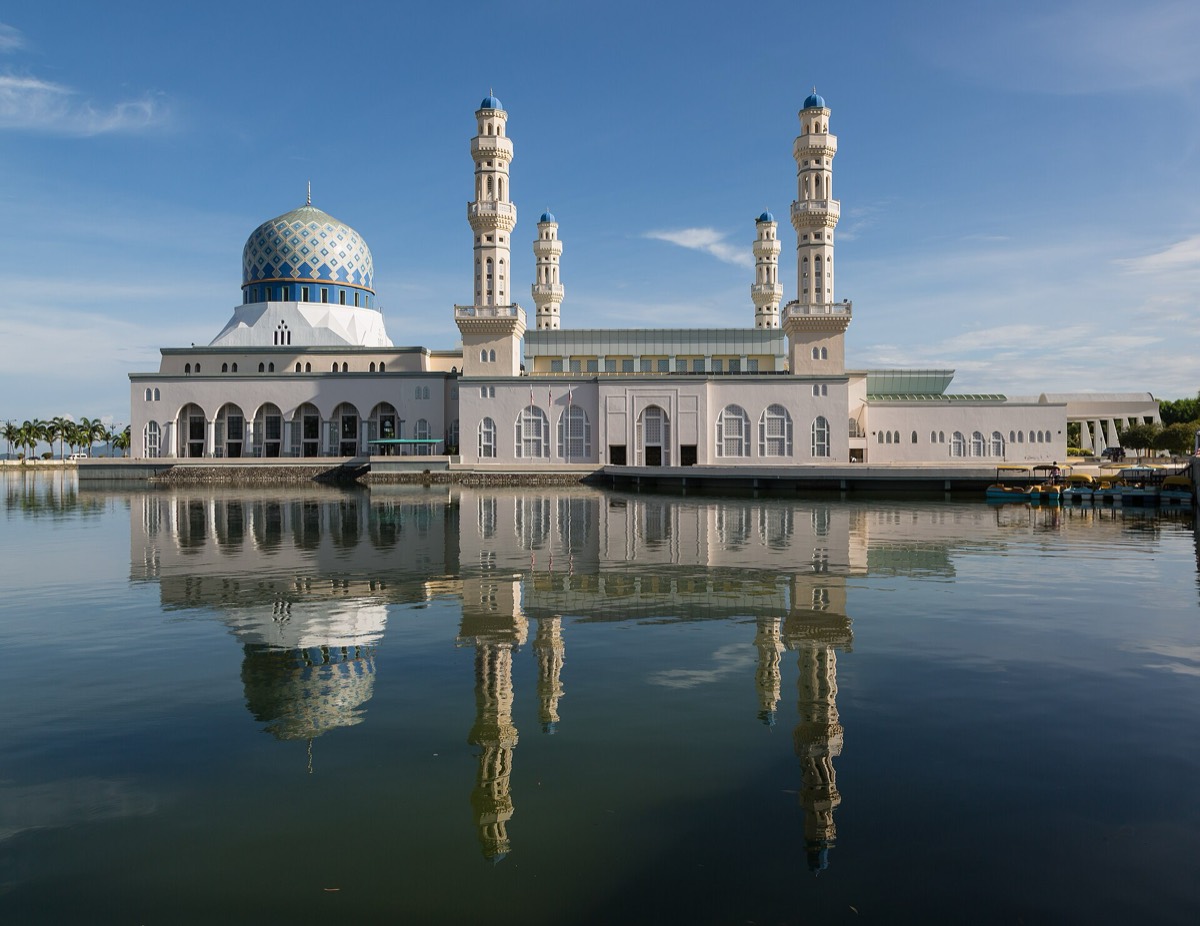
North of the centre, the City Mosque at Likas Bay is built beside an artificial lagoon, so its white domes reflect in the water. A few minutes away, the KK Wetland Centre is a protected patch of mangrove with a boardwalk, mudskippers, fiddler crabs and many birds, right among the suburbs.
The story
Sabah's history is told in the museum from the earliest archaeological finds, including stone tools and cave burials, through the time of the Sultanates of Brunei and Sulu, which both claimed parts of the coast, to the arrival of the British North Borneo Chartered Company in the 1880s. The company ran Sabah as a commercial territory, collecting taxes and granting land, until the Second World War.
After the war, North Borneo became a British crown colony, and in 1963 it joined the new federation of Malaysia as the state of Sabah. The name Sabah itself is old; its origin is debated, and theories link it to Brunei Malay or Arabic words. The English writer Agnes Keith's phrase 'Land Below the Wind', from her 1939 book, is still used as a nickname because the state lies just south of the typhoon belt.
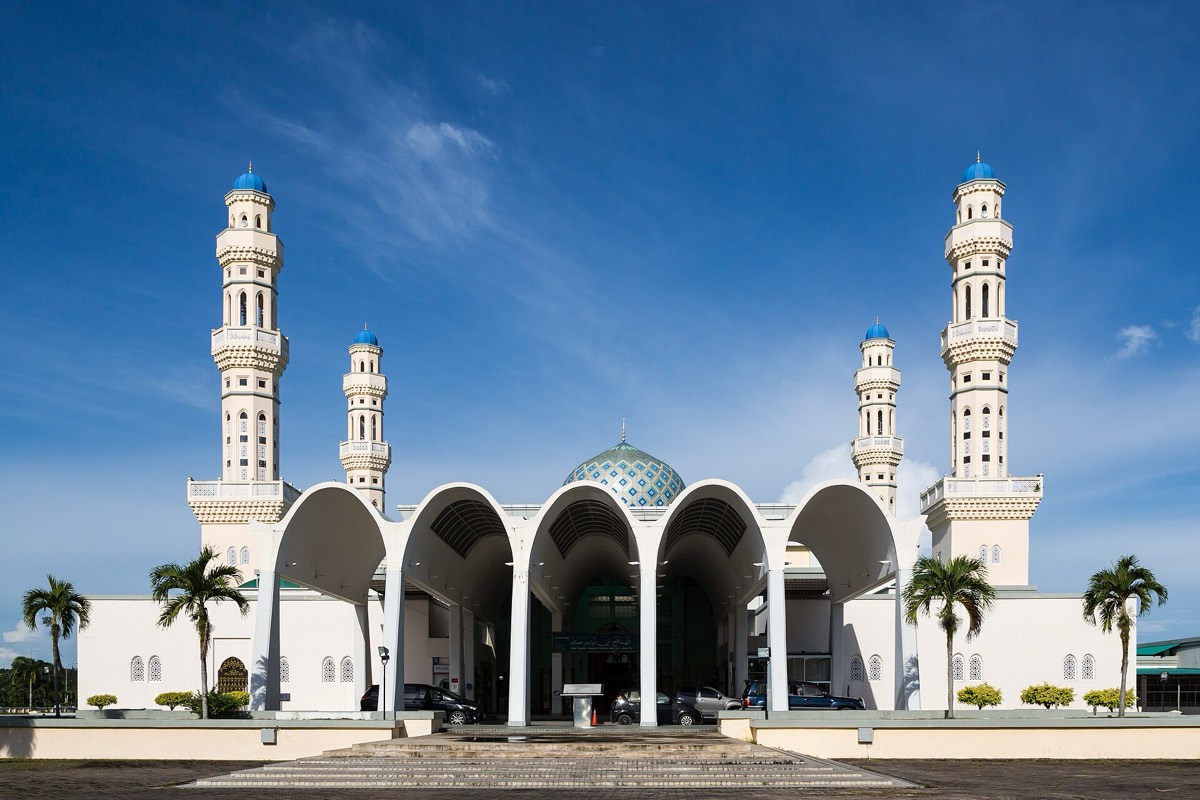
The City Mosque, completed in 2000, was designed in a style that recalls the Prophet's Mosque in Medina and can hold thousands of worshippers. The State Mosque near the museum is older, finished in 1977, with a golden dome. Both welcome respectful visitors outside prayer times.

Getting there
The Sabah Museum is about 3 km south of the centre on Jalan Muzium; a taxi takes ten minutes. The City Mosque is in Likas, about 7 km north, and the Wetland Centre is close to it.
Ride-hailing apps are the easiest way to link the three stops.
A suggested plan
- 9:00 amSabah Museum: main galleries, then the Heritage Village if it's dry.
- 12:30 pmLunch in the city or near the museum.
- 2:00 pmVisit the State Mosque in Sembulan on the way north if it's open to visitors.
- 3:00 pmCity Mosque at Likas: walk around the lagoon and look inside if allowed.
- 4:30 pmKK Wetland Centre boardwalk as the birds become active in the late afternoon.
Where to stay
Any central KK hotel works for this loop; Likas has some quieter places to stay near the bay.
Good to know
- Check museum opening days; it usually closes one weekday.
- Avoid mosque visits during Friday midday prayers.
- Wear long trousers or a long skirt and cover your shoulders for the mosques.
- Bring binoculars to the wetland centre if you have them.
- Mosquitoes are thick in the mangroves at dusk; use repellent.
- The paths around the museum's Heritage Village get slick in heavy rain.