Pha That Luang, the Great Golden Stupa
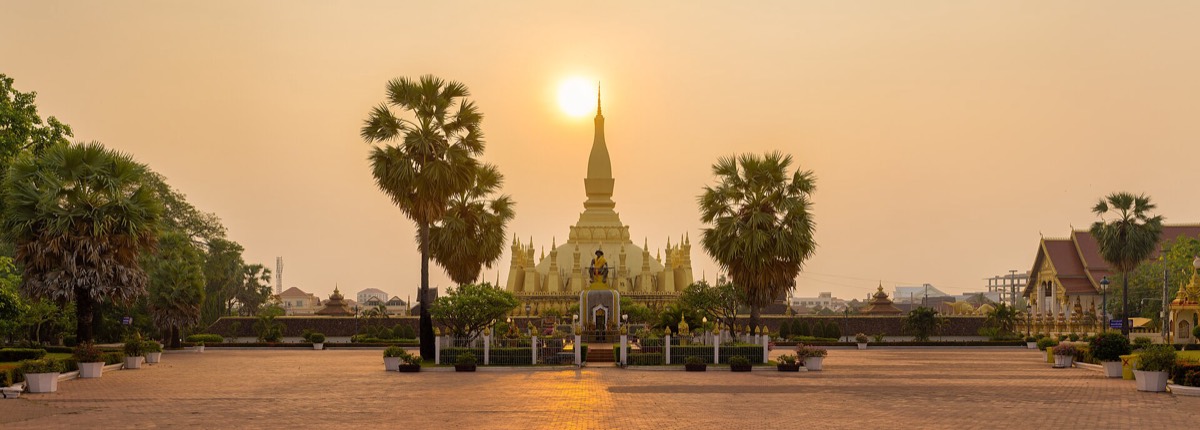
The gilded stupa on Lao banknotes and the national seal, best seen early in the morning when the gold glows soft and the courtyard is almost empty.

- Area
- Vientiane
- Start from
- Central Vientiane
- Distance
- about 4 km northeast of the riverfront
- Time needed
- half a day
- Best season
- November – February is coolest; the That Luang Festival falls around the November full moon
- Difficulty
- Easy
- Transport
- Tuk-tuk, ride-hailing app, bicycle, or a long walk via Patuxai
- Tickets & rules
- Small entry ticket; shoulders and knees covered, remove shoes where asked
Why go
If Laos has one image that stands for the whole country, it is this one: a tall, tapering golden spire rising out of a lotus-petal base, ringed by a cloister wall and a crown of smaller spires. You will have seen it already on banknotes and beer labels, but standing in front of it on a clear morning is different. The gold is not loud. In early light it looks almost like old brass, and the only sounds are sweeping brooms and pigeons.
The stupa stands about 45 metres tall on a broad terraced base, and you walk around it rather than into it. The cloister that surrounds it holds old Buddha images, some weathered, some freshly gilded, and the quiet galleries are one of the calmer places in the city to sit out the heat for a few minutes.
Around the main stupa there is more to see than people expect: two working monasteries, Wat That Luang Neua to the north and Wat That Luang Tai to the south, a long reclining Buddha in the southern grounds, and a vast open parade square that fills with pilgrims and stalls during the November festival.
The story
Legend says a relic of the Buddha, a piece of his breastbone, was brought here by missionaries sent by the Indian emperor Ashoka in the third century BC, and that a small stupa was built over it. Archaeologists are more cautious, but there was certainly a Khmer-era temple on the site long before the present structure, and the ground has been considered sacred for many centuries.
The stupa you see is largely the work of King Setthathirath, who moved the capital of the kingdom of Lane Xang from Luang Prabang to Vientiane in the 1560s and built Pha That Luang as its spiritual anchor. His statue stands in front of the entrance, sword across his knees, and people still leave flowers and incense at its base. For the next two and a half centuries the stupa was the centre of royal ceremony.
In 1827–28 Siamese armies sacked Vientiane after the failed uprising of King Anouvong, and the stupa was badly damaged and stripped. Later travellers described it overgrown and ruined. The French began a restoration around 1900 that was widely criticised for not resembling the original, and a second, more careful reconstruction in the 1930s used old drawings made by a French explorer to bring back the shape you see today.
The That Luang Festival, held over several days around the full moon of the twelfth lunar month, usually in November, is still the biggest religious event in the country. Before dawn on the main day, thousands of people kneel in the square with offerings of sticky rice for the monks, and in the evening there are candlelit processions around the stupa.

Getting there
Pha That Luang is at the northeastern end of That Luang Road, roughly 4 km from the riverfront. A tuk-tuk from the centre takes ten to fifteen minutes; agree on the price before you get in, or use a local ride-hailing app, which avoids haggling. If you enjoy walking, you can go via Patuxai and up the long, straight avenue, which takes about an hour.
Cycling is easy too: the roads in this part of town are wide and flat, and many guesthouses rent simple bicycles by the day.
A suggested plan
- 8:00Arrive near opening time, buy a ticket at the gate and walk the outer cloister clockwise before the sun gets high.
- 8:45Sit for a while in the shade of the galleries, then stand back in the square for the full view of the spires.
- 9:30Walk to Wat That Luang Tai in the southern grounds to see the reclining Buddha and the colourful newer halls.
- 10:15Visit Wat That Luang Neua to the north, a working monastery where you may hear chanting.
- 11:00Head back towards Patuxai, stopping for a Lao iced coffee on the way.
Where to stay
Most visitors base themselves in the compact riverside centre around Nam Phou fountain and Fa Ngum Road, where guesthouses, cafés and the night market are all within walking distance. That Luang is an easy short ride from there, and staying near the river means you can be back by the water for sunset.
Good to know
- Opening hours usually follow office hours with a lunch break, and the cloister may close on Mondays or public holidays; check before you go.
- The square in front has almost no shade. Bring water and a hat, and wear sandals that slip off easily.
- During the November festival accommodation fills up and prices rise, so book ahead if your dates overlap.
- For the best photograph, stand well back near the statue of King Setthathirath and include him in the frame.
- This is an active religious site: don't climb on walls or platforms, and never point your feet towards Buddha images when you sit down.
- Heat and glare off the paving can be intense by late morning; heatstroke is a real risk in March to May.