Patuxai and the Long Avenue
A walk up Vientiane’s grand boulevard to the monumental victory gate, with a climb to its rooftop for the widest view of the flat, green city.

- Area
- Vientiane
- Start from
- Nam Phou fountain
- Distance
- about 3 km on foot
- Time needed
- half a day
- Best season
- Cool season mornings or late afternoons
- Difficulty
- Easy
- Transport
- On foot, or a short tuk-tuk ride
- Tickets & rules
- Small fee to climb Patuxai; the park is free
Why go
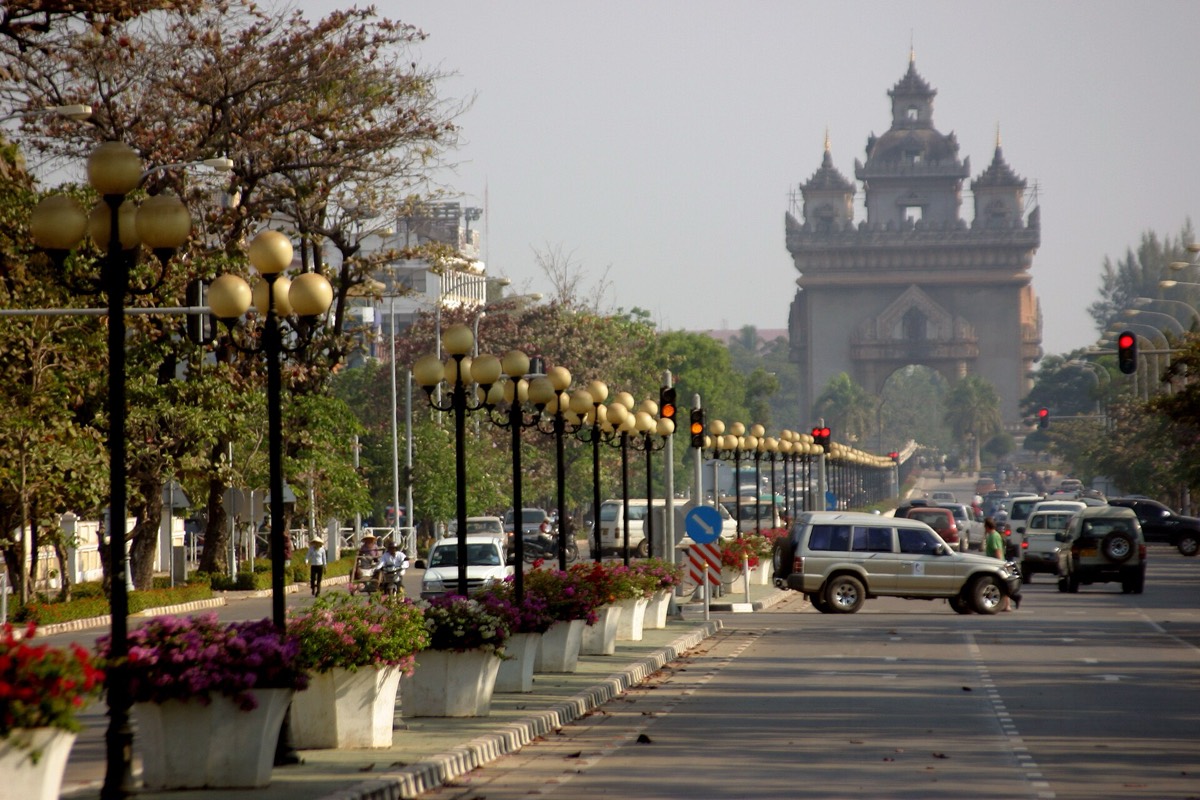
Lane Xang Avenue is Vientiane’s attempt at a ceremonial boulevard, a broad straight road that runs from the presidential palace near the river to the great gate of Patuxai. Walking it gives you a feel for the city’s scale: low buildings, wide sky, lines of trees and the occasional gilded temple roof between them.
Patuxai itself looks, at first glance, like a copy of the Arc de Triomphe, and it was clearly inspired by it, but up close it is thoroughly Lao. The ceilings are decorated with Hindu and Buddhist figures, the upper towers carry small stupa-like spires, and the whole thing has a slightly unfinished, hand-built quality that I find rather endearing.
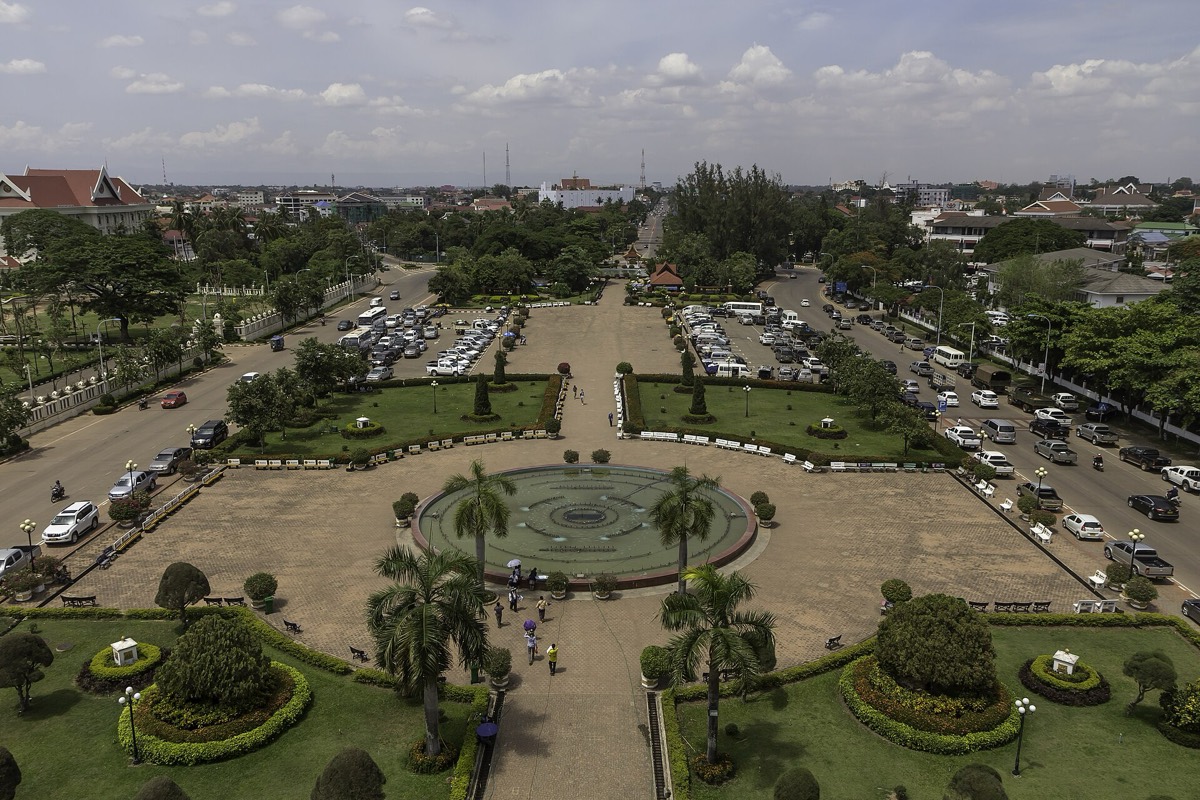
The best part is the climb. Stairs inside lead up past floors of souvenir stalls to open terraces at the top, where the whole city spreads out: That Luang glinting to the northeast, the avenue running down to the river and, on clear days, hills on the horizon.
The story
Patuxai, meaning roughly Victory Gate, was built between the late 1950s and the late 1960s as a monument to those who fought for independence from France. Construction was slow and, by most accounts, never quite completed to the original design; a sign that used to hang inside cheerfully described it as a monster of concrete, a line that travellers loved to quote.
The best-known story about the gate is that it was built with cement donated from abroad for a new airport runway, which is why it is sometimes nicknamed the vertical runway. It is one of those tales that every guide tells and that has become part of the monument’s character.
The park around it was landscaped in the 2000s with a large musical fountain and gardens, and a big ceremonial gong, the World Peace Gong, stands in a pavilion nearby. In the evenings the park is one of the places where families come to walk, children ride hired electric toy cars and couples take photographs against the lit arch.
Look up when you pass through the arch. The ceiling reliefs show Vishnu, Brahma and Indra, and the kinnari, the half-bird, half-woman figures of Southeast Asian legend, set among patterns borrowed from temple architecture across the country.

Getting there
Start at Nam Phou fountain in the old centre and walk north along Lane Xang Avenue; the gate is about 1.5 km away and visible almost from the start. On the way you pass the Morning Market area and several government buildings.
If the heat is too much, any tuk-tuk will take you to Patuxai in a few minutes, and you can continue onwards to That Luang, which lies another 1.5 km further.
A suggested plan
- 7:30Breakfast near Nam Phou fountain, then walk up Lane Xang Avenue while it is still cool.
- 8:30Arrive at Patuxai, look at the ceiling reliefs from below and walk around the gardens.
- 9:00Buy a ticket and climb to the top terraces for the views in every direction.
- 10:00Rest in the shade of the park near the fountain and the Peace Gong.
- 10:30Continue on foot or by tuk-tuk to Pha That Luang, or return south to the river for lunch.
Where to stay
The streets between Nam Phou fountain and the river are the most convenient base. They are full of small hotels, bakeries and noodle shops, and Patuxai is a pleasant straight walk away.
Good to know
- Come back after dark: the arch is lit and the fountain sometimes plays music in the evening.
- The stalls inside the gate are a cheap place for simple souvenirs like woven bags and postcards, but quality varies.
- The upper staircases are narrow; if you dislike heights, the first terrace already gives a fine view.
- Midday light is flat and harsh here. Morning and late afternoon are best for photographs.
- Traffic around the roundabout is fast and does not always stop for pedestrians; cross with care and use the signals.
- Avoid photographing the guarded government buildings along the avenue up close, and follow any instructions from guards politely.