Buddha Park, a Mystic’s Garden
A strange and wonderful riverside garden of more than two hundred concrete statues, a giant reclining Buddha and a pumpkin-shaped tower of hell, earth and heaven.

- Area
- Vientiane
- Start from
- Vientiane, Talat Sao bus station
- Distance
- about 25 km southeast
- Time needed
- half a day
- Best season
- Cool, dry months; mornings to avoid the heat
- Difficulty
- Easy
- Transport
- Local bus, tuk-tuk or taxi; a bicycle for the strong
- Tickets & rules
- Small entry ticket and a small fee for cameras
Why go
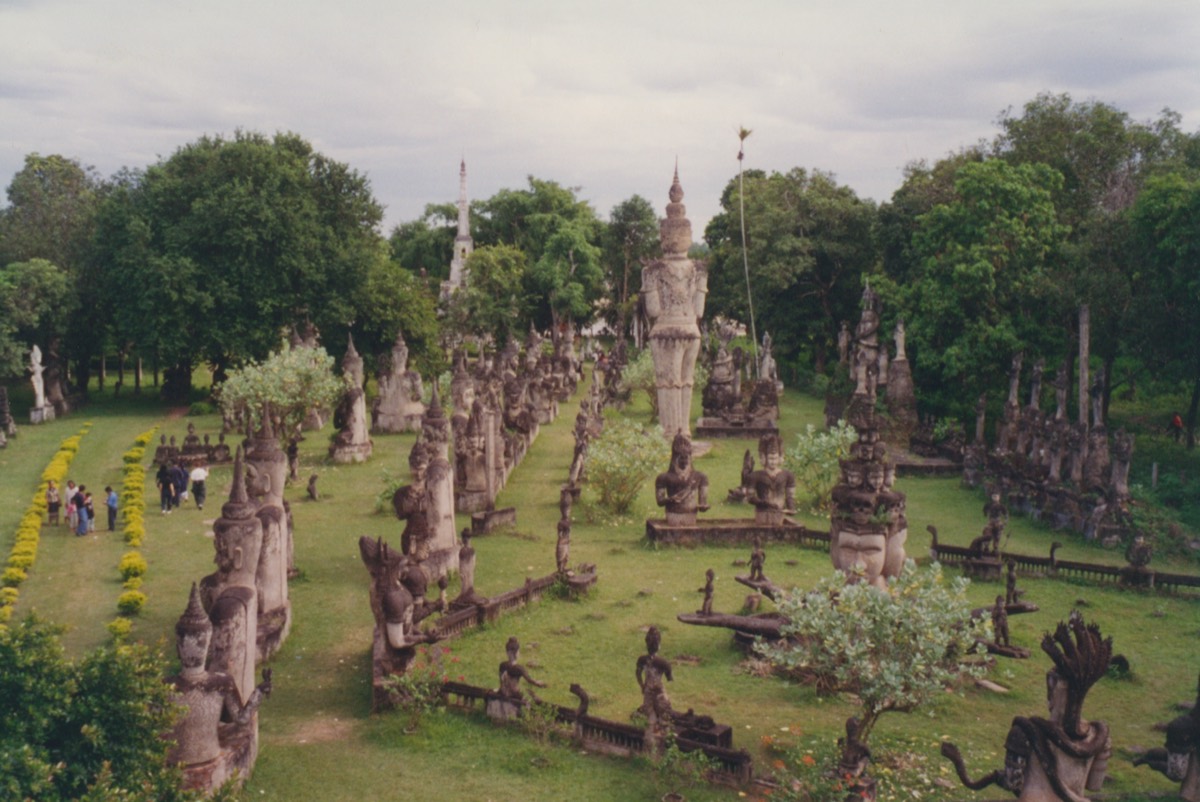
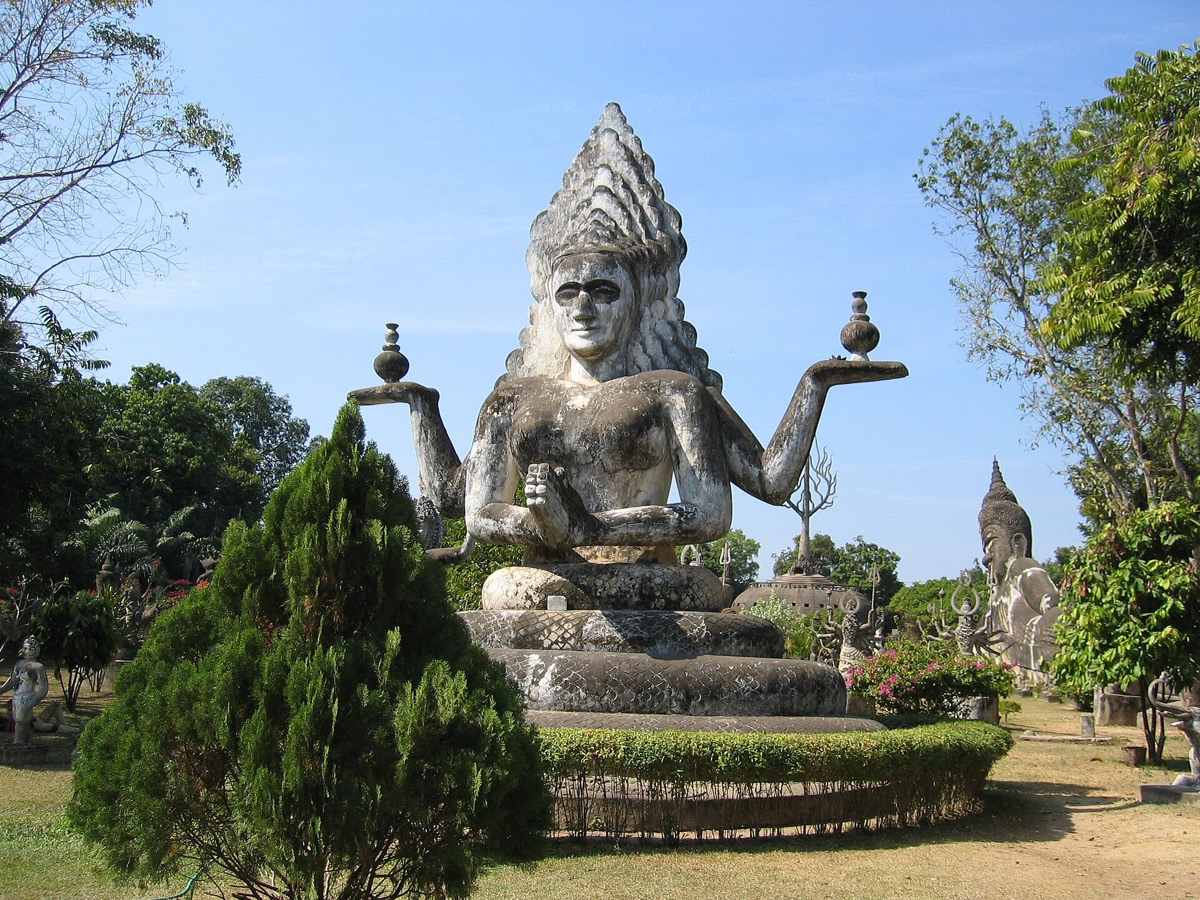
Xieng Khuan, everybody calls it Buddha Park, is the most eccentric place near Vientiane, and that is its charm. In a meadow by the Mekong stand more than two hundred concrete figures, Buddhist and Hindu side by side: a many-armed goddess, a reclining Buddha about 40 metres long, gods riding elephants, demons, animals and figures I still cannot name.
The statues are not ancient, they are only half a century old, but lichen and rain have given them a mossy, timeless patina. On a misty morning they look like the ruins of a lost city; in strong sun they become playful and almost cartoonish.
The centrepiece is a huge round structure shaped like a pumpkin. You enter through the open mouth of a demon’s head, climb up through three levels representing hell, earth and heaven, and emerge on the top for a view over the whole garden.
The story
The park was created from 1958 by Luang Pu Bunleua Sulilat, a priest, sculptor and mystic with a large following who combined Buddhist and Hindu teaching in his own way. Legend has it that as a young man he fell into a cave and met a hermit who taught him his ideas; whatever the truth, he built a following and an extraordinary set of sculptures.
He worked with his students and unskilled helpers, casting the figures in reinforced concrete, which explains their rough, hand-made feel. The figures were meant as teaching tools, showing the cycle of rebirth, the gods of the Hindu pantheon and the life of the Buddha.
In the mid-1970s, after the political change in Laos, he crossed the Mekong to Nong Khai in Thailand, where he built a second, even larger garden called Sala Keoku. If you go on to Thailand by road, it is worth seeing as a sequel. He died in 1996, and his mummified body is said to rest in the Thai garden.
Today the Vientiane park is looked after by the local authorities. Families come to picnic in the shade, local couples pose for photos, and on festival days there are flowers and offerings at the base of some statues.

Getting there
Public bus number 14 runs from the Talat Sao bus station near the Morning Market towards the Friendship Bridge and Buddha Park; it takes about an hour and is very cheap. The last stretch runs on a bumpy road past the bridge.
A tuk-tuk for a half-day round trip is the easiest option. Negotiate a price that includes waiting time, usually an hour or two. Cycling is possible but the route along the main road is busy and hot.
A suggested plan
- 8:00Take bus 14 from Talat Sao or set off by tuk-tuk while the morning is still cool.
- 9:00Arrive at the park, buy tickets and walk first to the reclining Buddha.
- 9:45Enter the pumpkin tower through the demon’s mouth and climb to the top.
- 10:30Wander among the smaller statues and sit in the riverside shade with a coconut.
- 11:30Head back to Vientiane, stopping at the Friendship Bridge for a look at the Mekong.
Where to stay
Stay in central Vientiane; the park is an easy morning trip, and there is no need to stay out by the bridge.
Good to know
- The steps inside the pumpkin are narrow and dark; a phone torch is helpful.
- There are drink and snack stalls at the entrance, so you do not need to carry much.
- If you are crossing into Thailand at the Friendship Bridge, you can visit on the way with luggage in a tuk-tuk.
- Mornings bring softer light and fewer tour groups.
- The top of the pumpkin has low railings; keep children close.
- Agree on the full price, including waiting time, before you leave with a tuk-tuk driver.