Rinjani: the crater rim and Segara Anak lake
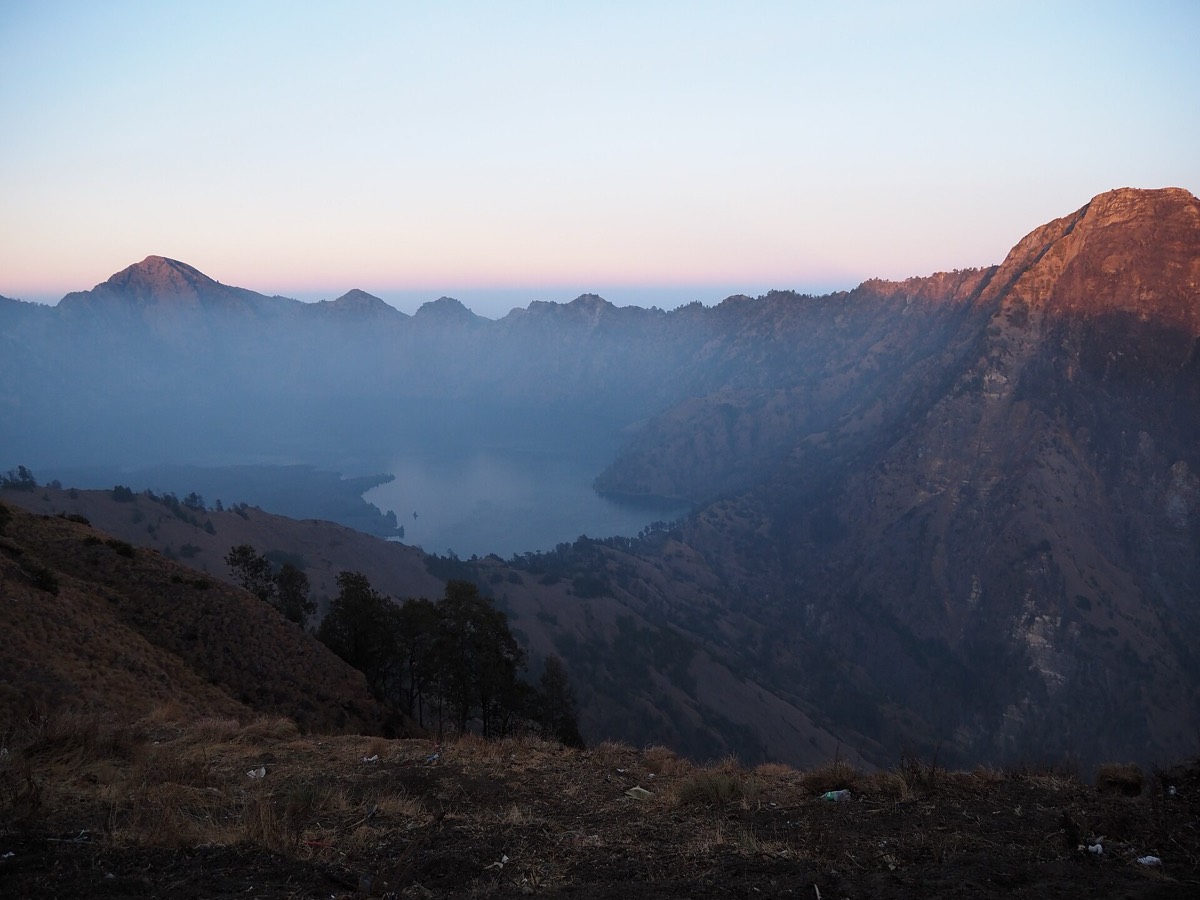
Two or three days on foot through jungle and grassland to the rim of a vast caldera, with a turquoise lake below, a smoking young cone in its middle and hot springs on its shore.

- Area
- Rinjani & Senaru
- Start from
- Senaru or Sembalun
- Distance
- about 20–30 km on foot depending on route
- Time needed
- 2–3 days
- Best season
- Roughly April – December; the park usually closes in the wettest months, often January – March
- Difficulty
- Hard
- Transport
- Transfer to the trailhead, then on foot with a licensed guide and porters
- Tickets & rules
- National park ticket booked in advance; licensed guide or registered trekking operator required
Why go
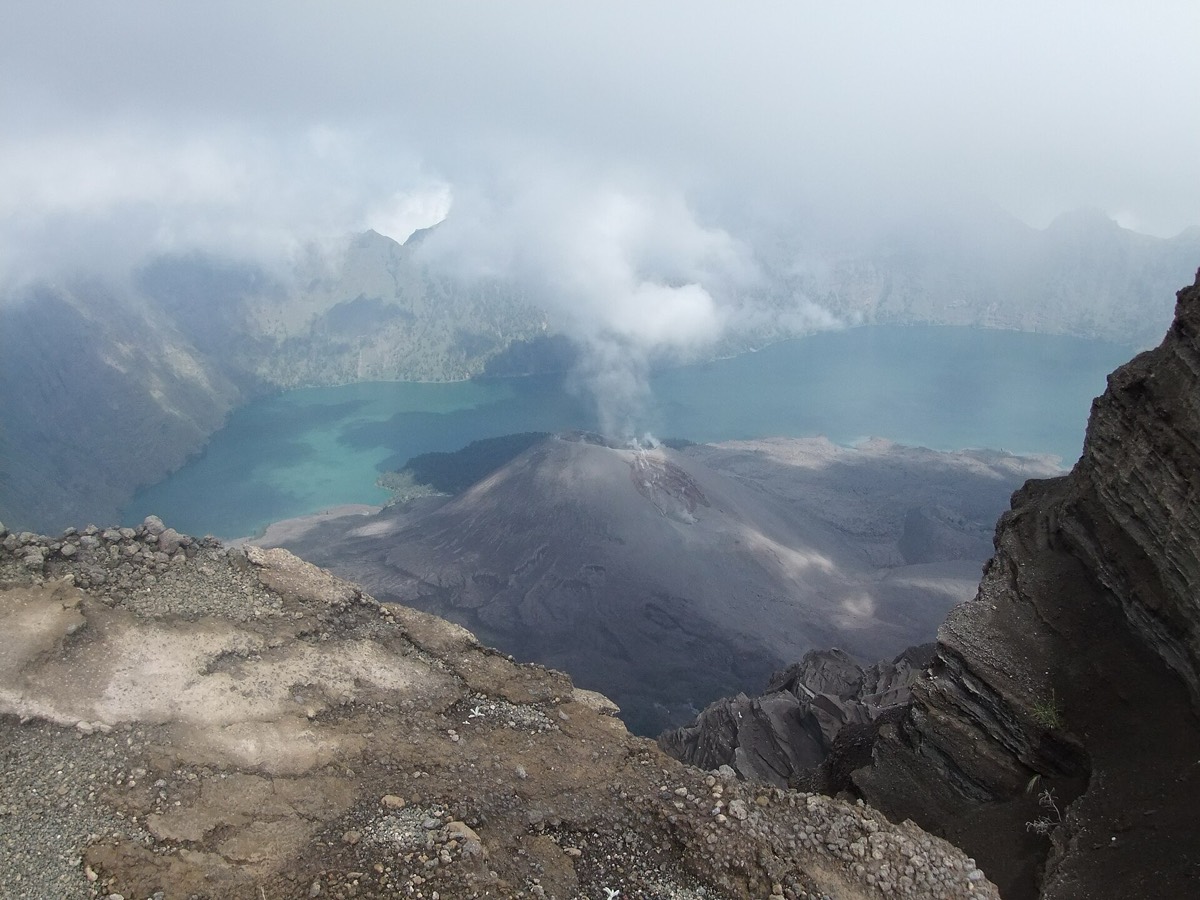
Gunung Rinjani, at about 3,726 metres, is the second-highest volcano in Indonesia, and it dominates Lombok in a way no single mountain dominates Bali. Inside its broken summit is a caldera roughly six by eight kilometres across, holding a crescent-shaped lake called Segara Anak, the ‘child of the sea’, at about two thousand metres. From its waters rises a young volcanic cone, Gunung Barujari, which still smokes and has erupted several times in recent decades.
The classic trek climbs from Senaru through tall forest full of birdsong and macaques to the crater rim at about 2,600 metres, where you camp above a sea of clouds. At dawn the whole caldera fills with light: the lake, the black cone, the main summit standing over it, and beyond, on clear days, Bali’s Mount Agung.
Many treks then descend steeply to the lakeshore, where hot springs bubble out of the rock into pools. Soaking your legs there after the descent, with the walls of the caldera rising all around, is a moment that stays with you for years.
The story
Segara Anak exists because of one of the largest volcanic eruptions of the last few thousand years. In 1257 an older volcano here, called Samalas, exploded and collapsed, leaving the caldera. For centuries scientists knew from ice cores in Greenland and Antarctica that a huge eruption had happened somewhere around that time, but nobody knew where. In 2013 a team of researchers published evidence pointing to Samalas, partly using old Sasak chronicles written on palm leaves.
Those chronicles, the Babad Lombok, describe a disaster that destroyed a royal city called Pamatan, with fire and ash pouring down the mountain and people fleeing. Archaeologists have wondered ever since whether the town lies somewhere under the thick ash deposits of north Lombok.
For the Sasak people and for Lombok’s Hindu Balinese community, Rinjani is sacred. Pilgrims climb to the lake to make offerings, and the Balinese hold a ceremony called Pekelan, putting small gold and silver objects into the water. Some Sasak Muslims and Wetu Telu followers also come to bathe in the hot springs for healing.
Rinjani National Park was established in 1997, and the wider area became a UNESCO Global Geopark in 2018. The rules for trekking have tightened over the years, especially after accidents, with online registration, required guides and limits on numbers. Treat this as a serious mountain: the paths are steep, loose and exposed in places, and the weather changes fast.

Getting there
The two main trailheads are Senaru on the north side and Sembalun on the northeast. Most trekkers book a package with a licensed operator that includes transfers, tickets, guide, porters, tents and food. You can arrange this in Senaru or Sembalun, or in Senggigi, Kuta or the Gilis.
A common two-day route goes Sembalun to the Sembalun crater rim and back; three-day routes often cross from Sembalun to Senaru via the lake. Check the current state of each trail before you book, as sections are closed after landslides.
A suggested plan
- Day 1 morningRegister at the park office and start climbing through forest or grassland.
- Day 1 afternoonSteep final climb to the crater rim; camp and watch the light change over the caldera.
- Day 2 dawnSunrise on the rim; summit climbers set off around 2–3am from the Sembalun side.
- Day 2 dayDescend to Segara Anak, swim or soak at the hot springs, camp by the lake.
- Day 3Climb out to the opposite rim and descend to Senaru or Sembalun.
Where to stay
Spend the night before in Senaru or Sembalun to acclimatise a little and make an early start easy. Both villages have homestays used to trekkers, and many can store luggage while you are on the mountain.
Good to know
- Bring warm layers, a hat and gloves: nights on the rim can drop close to freezing.
- Good shoes matter more than anything; the volcanic scree is loose.
- Ask your operator about rubbish policy and carry out what you carry in.
- Check the porters’ equipment and conditions; good operators look after their teams.
- Altitude, cold and exhaustion are real risks. Turn back if you feel unwell.
- Do not walk off-trail near the rim or on the scree; falls here have been fatal.
- The park may close suddenly for eruptions, fires or bad weather; keep a spare day.