Batu Cermin: the mirror rock cave
A limestone outcrop just outside town, where narrow passages hold marine fossils and, on bright days, a beam of sunlight that turns the rock walls into mirrors.

- Area
- Labuan Bajo
- Start from
- Labuan Bajo
- Distance
- about 4 km from the harbour
- Time needed
- half a day
- Best season
- All year; best around midday on sunny days
- Difficulty
- Easy
- Transport
- Ojek, car or a hot walk
- Tickets & rules
- Entrance ticket; optional local guide inside the cave
Why go
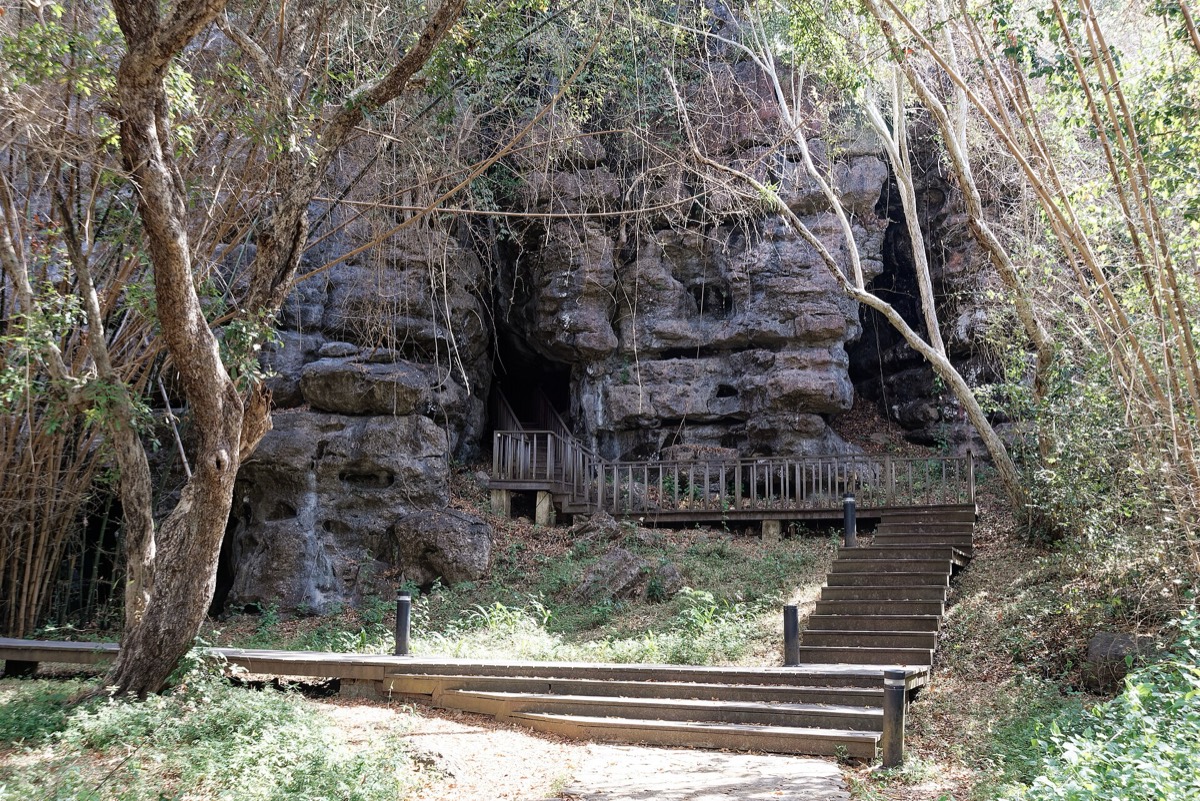
Batu Cermin is the easy half-day escape from the harbour, and it is the best thing to do in Labuan Bajo when the sea is too rough for boats or you need a break between trips. The outcrop rises sharply from a quiet patch of scrub and fields on the edge of town, a grey fortress of limestone about fifty metres high, full of cracks, chimneys and hidden chambers.
Inside, the passages are tight in places. You squeeze sideways, duck under overhangs and sometimes crawl for a few metres, wearing a helmet the guides hand out. The reward is the cave’s name: on clear days, around the middle of the day, sunlight slips through a gap in the roof and hits a wall of wet crystalline stone, which reflects it like a mirror into the dark.
Look carefully at the walls and you will also see fossils: fragments of coral, shells and, the guides will show you, the outline of what looks like a sea turtle. They are the reminder that this rock once lay under the sea. It is a quiet, cool, slightly eerie place, and an hour inside is a good counterweight to days on bright water.
The story
The cave became known to outsiders through Theodor Verhoeven, a Dutch Catholic priest who taught in Flores and was also a keen archaeologist. In the early 1950s he explored and described Batu Cermin. Verhoeven is better known for his work in central Flores, where he found stone tools near ancient animal bones and argued, long before most scientists agreed, that early humans had reached the island a very long time ago.
Local people had their own stories about the rock long before that. One is that the cave once sheltered villagers from raids along the coast, which is plausible given the hidden chambers. Another says the flashing light from the mirror wall was a sign of spirits living in the stone, and that offerings were left at the entrance.
Geologically, the outcrop is an old reef, lifted out of the sea as the islands of eastern Indonesia were pushed up by colliding plates. The same forces created the volcanoes inland and the steep, broken coastline of Komodo. Standing inside a former reef, an hour’s boat ride from living ones, is a nice way to understand how young and restless this landscape is.
Getting there
Batu Cermin lies a few kilometres east of the harbour, signposted off the road towards the airport. An ojek takes ten minutes or so; walking is possible but hot and dusty along the road.
At the entrance there is a ticket office and a small park with paths and boardwalks around the outcrop. Local guides wait near the gate and are worth hiring for the inner chambers.
A suggested plan
- Late morningRide out to Batu Cermin and buy tickets at the entrance.
- Around middayGo inside with a guide to catch the light on the mirror wall.
- Early afternoonWalk the boardwalk around the outcrop and look for birds in the trees.
- AfternoonReturn to town for lunch and a rest before sunset.
Where to stay
There is no reason to stay out here; base yourself in town. The cave pairs well with a slow day before or after a boat trip, or with an early flight, since it is close to the airport road.
Good to know
- The mirror effect depends on sun; on cloudy days the cave is still worth it, but the famous beam may not appear.
- Wear shoes with grip and clothes you don’t mind getting dusty.
- Bring a small torch even if guides provide one.
- Passages are narrow and low; if you are claustrophobic, stay in the outer chambers.
- Bats live in the cave; don’t touch them, and wash any scratches carefully.