Tonle Bati: Ta Prohm by the Lake
A small, lovely Angkorian temple of carved sandstone and laterite, beside a lake where Phnom Penh families come to swim and picnic.

- Area
- Day trips
- Start from
- Phnom Penh
- Distance
- about 35 km south
- Time needed
- half a day to 1 day
- Best season
- November – April; any time of year with patience
- Difficulty
- Easy
- Transport
- Car or tuk-tuk along National Road 2
- Tickets & rules
- Small entry fee for foreign visitors (a few USD); modest dress in the temples
Why go
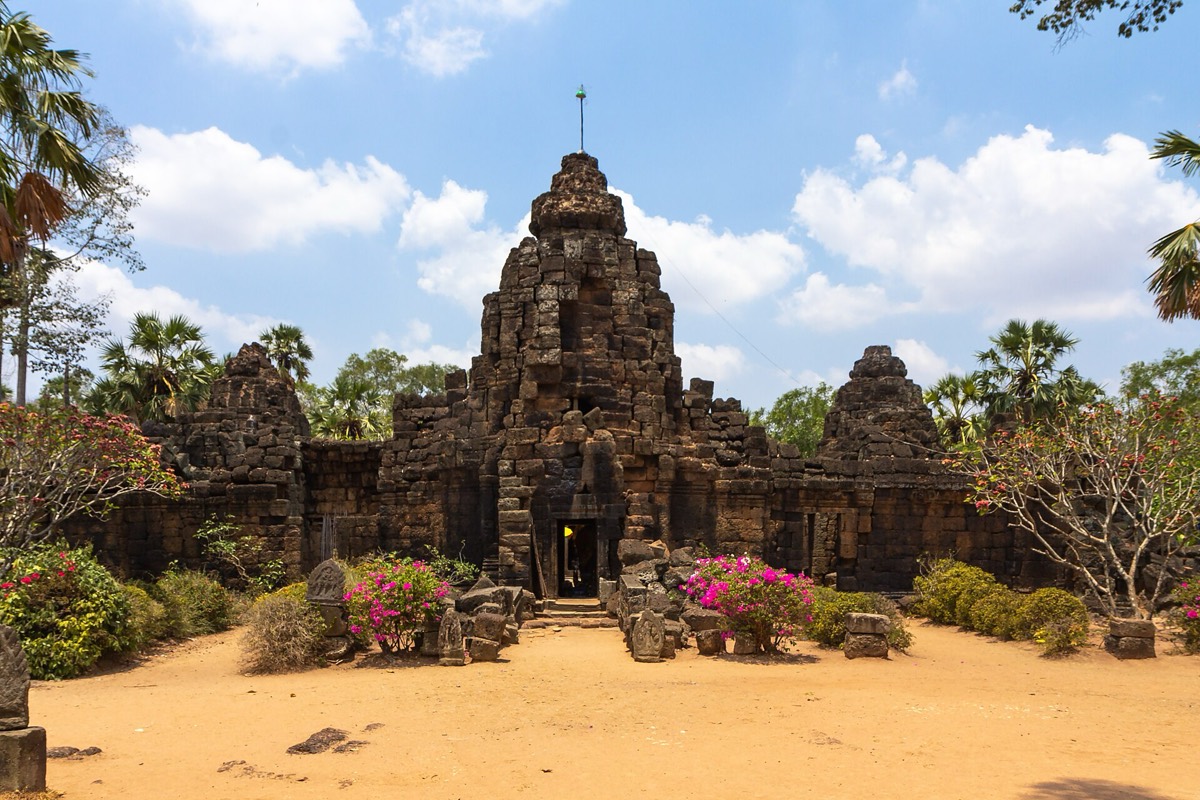
If you are not going to Angkor, or if you want a taste of it close to the capital, Tonle Bati is the place. Here, among trees and rice fields, stands a twelfth-century temple called Ta Prohm, the same name as its famous cousin at Angkor, with corridors, towers and some of the most delicate carvings in the region.
It is small enough to see in an hour, and most of the time you have it almost to yourself, apart from an old caretaker and a few children selling flowers. Look closely at the walls: apsaras, scenes of daily life, and a famous panel showing a woman carrying a box on her head, which is said to tell a story of punishment and forgiveness.
A short walk away the lake has stilted picnic huts over the water, where you can eat, swim and rest. It makes a perfect easy day: culture in the morning, hammock in the afternoon.
The story
Ta Prohm of Tonle Bati was built in the late twelfth century, in the reign of Jayavarman VII, the great Buddhist king who also built the Bayon and the Ta Prohm at Angkor. It stands on the site of an older shrine, and it was later used and remodelled by Buddhists of later centuries, which explains the mix of Hindu and Buddhist imagery.
The temple is built of laterite, the rusty, pitted stone used for foundations and walls, with fine sandstone for the carved lintels and decoration. Some of the carvings are among the best preserved in the Phnom Penh region, because the site was less exposed than many others.
Close by stands the smaller Yeay Peau temple, named after a legendary woman, the mother of a king in local tradition, and still an active place of worship.
The lake itself, Tonle Bati, is fed by the rains, and in the dry season the water level drops. On weekends and holidays it is full of families and groups of friends, music and food smells, and the contrast with the quiet temple is part of the charm.
Getting there
Tonle Bati lies about thirty-five kilometres south of Phnom Penh along National Road 2. A car or tuk-tuk takes around an hour; turn off the main road at the signposted gateway and follow the lane to the ticket booth.
It combines well with Phnom Tamao Wildlife Rescue Centre or Phnom Chisor further south on the same road.
A suggested plan
- 8 amLeave the city by car or tuk-tuk, heading south on Road 2.
- 9 amExplore Ta Prohm slowly, walking around the outer galleries and looking for the carved panels.
- 10 amVisit the small Yeay Peau temple nearby.
- Late morningRent a hut by the lake; swim, eat grilled fish and rest in a hammock.
- AfternoonReturn to Phnom Penh, or continue south to Phnom Chisor.
Where to stay
Visit from Phnom Penh; Tonle Bati is an easy half-day.
Good to know
- Weekdays are quieter at the lake.
- Bring a torch to see carvings in shaded corners.
- Agree the price of a lake hut and food before ordering.
- Combine with another stop on Road 2 to make a full day.
- Child flower sellers may follow you; a gentle no is fine.
- Don’t climb on fragile parts of the temple.
- Swim only in shallow areas where others swim.