Inside the fish-sauce barrel houses
Giant wooden vats, salt, anchovies and patience: visit the long sheds where Phu Quoc’s most famous product ferments for a year or more.

- Area
- Duong Dong & west coast
- Start from
- Duong Dong town
- Distance
- a few km around town
- Time needed
- half a day
- Best season
- All year; main anchovy season roughly in the dry months
- Difficulty
- Easy
- Transport
- Taxi, scooter or bicycle
- Tickets & rules
- None; some houses welcome visitors only at certain hours
Why go
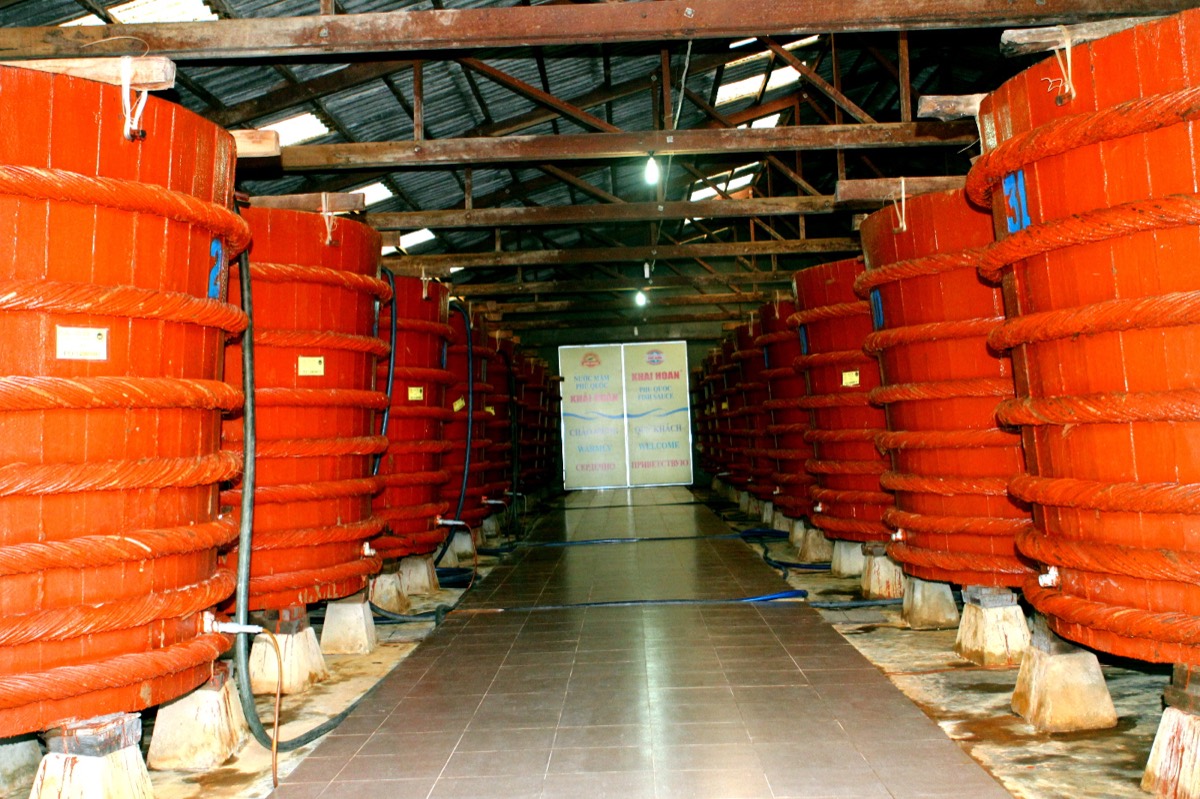
Before pepper or beaches, Phu Quoc was famous for one thing: nước mắm, fish sauce. Around Duong Dong there are still dozens of fermenting houses, long dim sheds full of enormous wooden barrels, each taller than a person, held together with rattan or steel hoops. Step inside and the smell is overwhelming for about a minute, then strangely pleasant, savoury and sweet like a very old cheese.
Several of the larger houses are used to visitors. A worker will usually show you the barrels, explain the process and let you taste a drop of the first, clearest pressing on the back of your hand or on a spoon. It is much more delicate than the bottled sauce most people know from the supermarket.
It is one of the few places on the island where you can see a traditional industry at work without any staging, and it explains half of what you will eat here.
The story
The basic recipe is simple: fresh anchovies, called cá cơm, are layered with sea salt in the barrels as soon as they are landed, roughly three parts fish to one part salt. Then nothing much happens for a year or more. Enzymes in the fish slowly break down the proteins, and a clear amber liquid collects at the bottom, drained through a tap and sometimes poured back over the top to keep the process even.
The barrels, called thùng lều, were traditionally made from local hardwoods that do not taint the sauce, and some families still keep vats that have been in use for several decades. Quality is measured in ‘degrees’ of protein; the first draw from a good barrel is the strongest and most prized, while later draws are blended and diluted.
In 2012 ‘Phu Quoc’ fish sauce was granted protected designation of origin status in the European Union, one of the first Southeast Asian products to receive it. It means that, in principle, only sauce made on the island from local anchovies and in the traditional way can carry the name in Europe.
The trade has a long history. Fish sauce from this coast was being shipped to the mainland a couple of centuries ago, and in the twentieth century Phu Quoc and Phan Thiet were the two great names in Vietnamese fish sauce, a bit like rival wine regions. Older islanders can still tell you which family’s sauce their grandmothers preferred.
Getting there
Most of the fermenting houses are on the edges of Duong Dong, along the roads leading inland and north from town. Hotel staff can name the ones that welcome visitors; some larger producers run regular open hours and simple tasting counters.
A taxi or ride-hailing car for a couple of hours is easiest. If you have a scooter licence and experience, it is a pleasant short ride; a bicycle works for the houses closest to town.
A suggested plan
- 9:00Start at a larger, visitor-friendly producer near Duong Dong while it is still cool inside the sheds.
- 9:45Walk the barrel rows, ask about salt ratios and how long each vat has been aging.
- 10:30Taste the different grades side by side, and notice how the first press is almost sweet.
- 11:15Visit a smaller family house if your driver knows one, where the scale is more domestic.
- 12:00Lunch on rice with braised fish and a saucer of the good stuff, so you know what you’ve learned.
Where to stay
Duong Dong and Long Beach are the obvious bases. This route is short enough to combine with the pepper farms or the Dinh Cau dawn walk on the same day.
Good to know
- Wear old clothes and closed shoes: the smell clings and floors can be wet with brine.
- If you buy sauce, ask for it sealed and wrapped for shipping; some producers can arrange delivery to the mainland.
- Ask about protein degrees (đạm) on the label; higher numbers mean a stronger, more concentrated sauce.
- Vietnamese airlines generally do not allow fish sauce on board, in either cabin or checked luggage, after past leaks; check before buying bottles to take home.
- Floors around barrels are slippery, and some sheds have open drains; watch children closely.