Po Nagar towers, the river mouth and Hon Chong at sunrise
A dawn walk among granite boulders, then up the steps of a Cham sanctuary that has watched over the Cai river mouth for well over a thousand years.

- Area
- Nha Trang town
- Start from
- Central Nha Trang
- Distance
- about 3–4 km from the centre
- Time needed
- half a day
- Best season
- All year; early morning is best
- Difficulty
- Easy
- Transport
- Taxi, ride-hailing motorbike or bicycle
- Tickets & rules
- Small entry tickets at Po Nagar and Hon Chong; shoulders and knees covered at Po Nagar
Why go
Nha Trang is at its gentlest before seven in the morning. The light comes in low across the bay, swimmers are already out in the flat water, and the headland of Hon Chong, a pile of smooth granite boulders pushing into the sea just north of the river, is quiet enough to hear the waves sucking between the rocks. Locals come here to sit, stretch and watch the islands turn from grey to green.
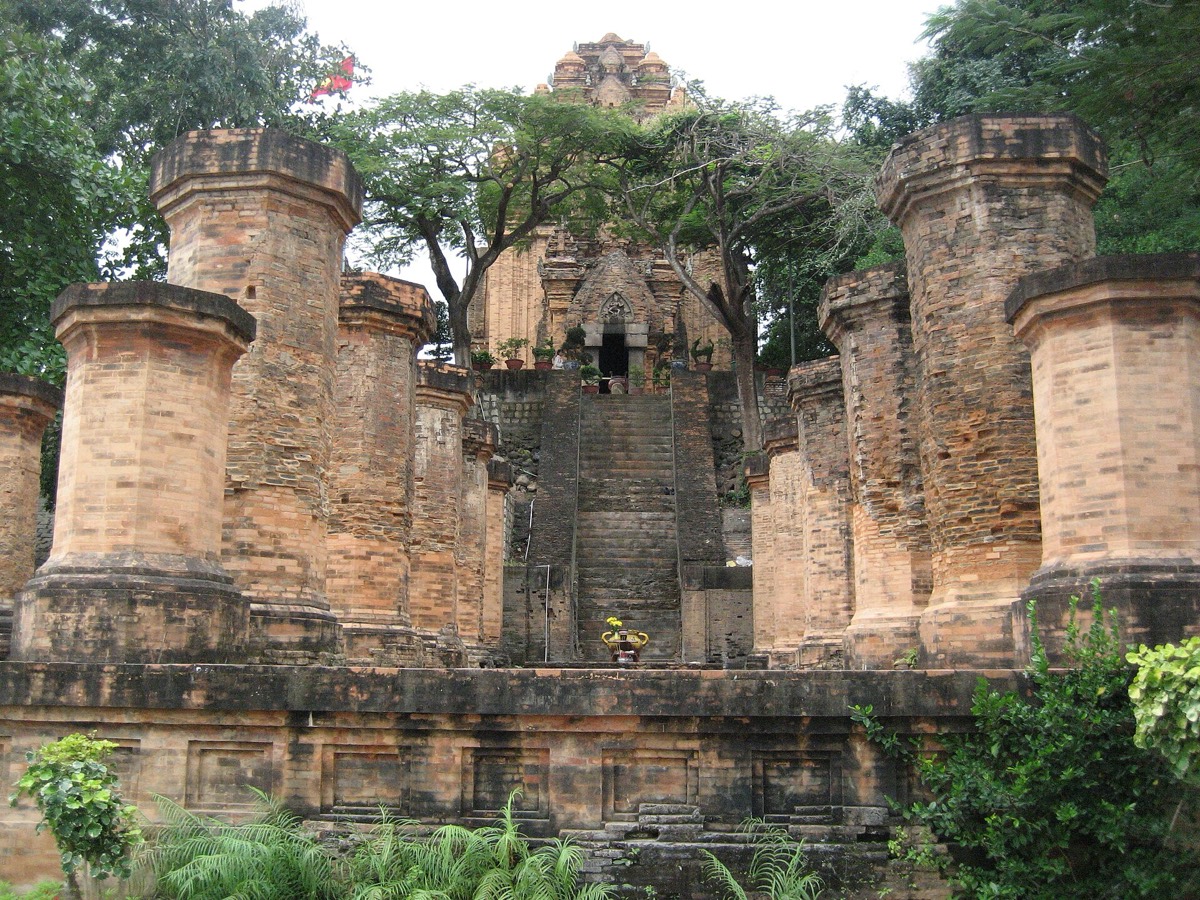
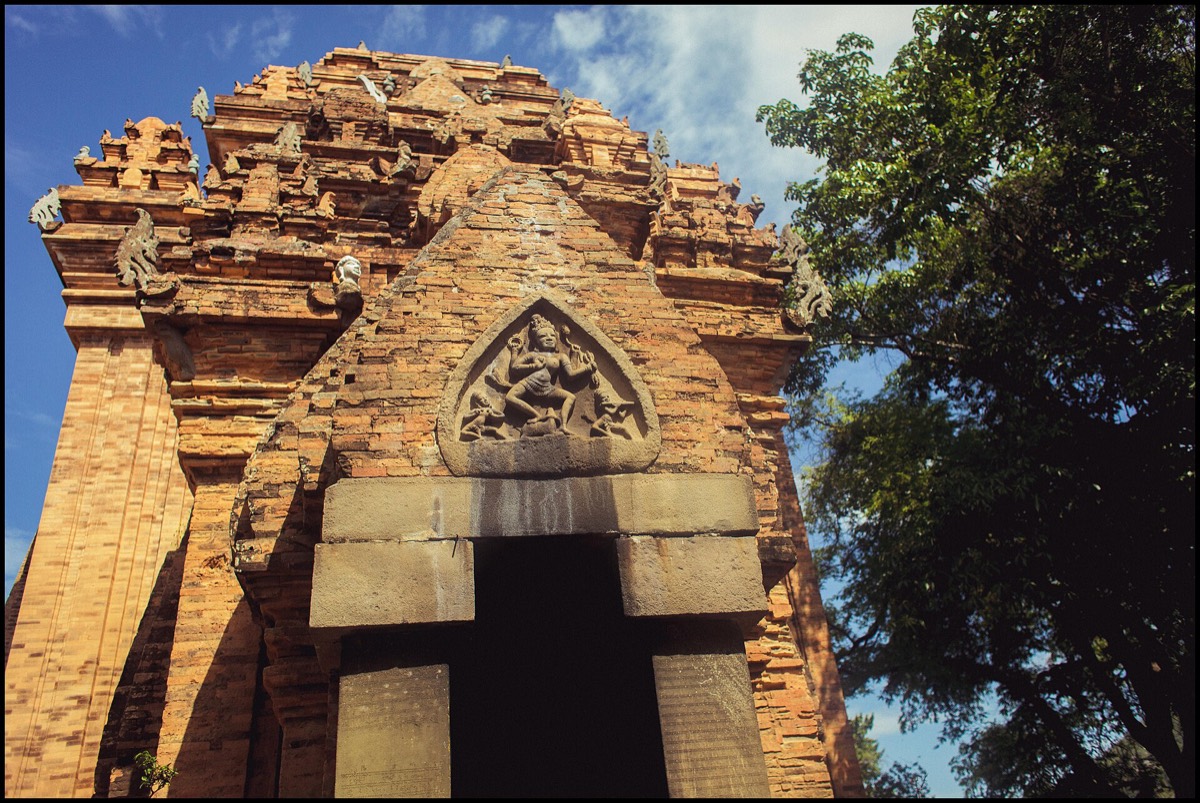
A short ride away, the Po Nagar towers stand on a low hill above the mouth of the Cai river. They are the most important surviving Cham sanctuary on this stretch of coast: brick towers the colour of baked earth, carved sandstone lintels, a forest of pillars from a vanished hall, and incense smoke drifting from the main shrine, where people still come to pray.
Between the two, the Xom Bong bridge looks down on a river crowded with blue-painted fishing boats. In the early morning they come home, baskets of fish are passed hand to hand onto the bank, and the whole scene feels a world away from the hotel towers a kilometre to the south.
The story
The Cham were the people of Champa, a group of kingdoms that ruled the central coast of what is now Vietnam for more than a thousand years. Their culture drew heavily on India: Hindu gods, Sanskrit inscriptions, towers built of fired brick so finely laid that archaeologists still argue about how they were bonded. Kauthara, the Cham principality around Nha Trang, was one of the oldest and most sacred parts of their world.
Po Nagar was dedicated to Yang Ino Po Nagar, the mother goddess of the land, later identified with Bhagavati, a form of Shiva’s consort. Inscriptions record that in the late eighth century raiders from overseas, often thought to be from Java, burned the original wooden temple and carried off its sacred image, and that a Cham king rebuilt it in brick soon afterwards. Most of what you see today dates from roughly the eighth to the thirteenth centuries.
When the Vietnamese moved south and absorbed the region, they did not abandon the goddess. They took her in as Thiên Y A Na, a mother goddess of the Vietnamese tradition, and the shrine has been in continuous use ever since. Every spring, around the twentieth to the twenty-third day of the third lunar month, a festival brings dancers, offerings and crowds of pilgrims up the hill.
Hon Chong has its own legend. A giant, so the story goes, came to spy on a fairy bathing in the sea here, slipped, and left the print of his enormous hand on a boulder. You can still see a hand-shaped hollow in the rock, and people still pose with their palms in it.

Getting there
Hon Chong is about 3 km north of the main beach, and Po Nagar is a few hundred metres from the north end of the Xom Bong bridge. Ride-hailing apps work well in Nha Trang, and a bicycle is pleasant along the coast before the traffic builds.
Combine both in one loop: Hon Chong first for sunrise, then the bridge, then Po Nagar when it opens in the morning, before the tour buses arrive.
A suggested plan
- 5:15–6:30Hon Chong headland for sunrise over the bay; climb the boulders carefully.
- 6:30Walk or ride to the Xom Bong bridge and watch the fishing boats come in.
- 7:00Breakfast nearby: a bowl of fish-cake noodle soup at a street stall.
- 7:30–9:00Po Nagar: the main tower, the pillared hall and the small museum displays.
- Late morningBack to town before the heat, or continue to the Long Son pagoda.
Where to stay
Stay near the northern end of Tran Phu street or just across the river if you want sunrise walks to be easy; the area around the Xom Bong bridge feels more local than the hotel strip further south.
Good to know
- Carry a scarf or light trousers for Po Nagar; wraps are sometimes available at the gate.
- Take your shoes off where signs ask you to, and don’t climb on the altars or the old brickwork.
- At Hon Chong, rubber-soled shoes help on the smooth, sometimes damp granite.
- Traditional Cham dance performances are sometimes held at Po Nagar during the day; check at the entrance.
- The boulders at Hon Chong are slippery and the surf can surge between them; stay off the lower rocks when the sea is rough.
- Po Nagar is an active place of worship: speak quietly, don’t photograph people praying up close, and don’t point your feet at the altar.