Hoi An old town: bridges, halls and merchant houses
A morning wandering the mustard-yellow lanes of a 16th-century trading port, where a Japanese bridge, Chinese assembly halls and wooden merchant houses still stand side by side.

- Area
- Hoi An old town
- Start from
- Hoi An
- Distance
- walking distance, about 3–4 km of lanes
- Time needed
- 1 day
- Best season
- All year; February – April is the most comfortable
- Difficulty
- Easy
- Transport
- On foot or by bicycle
- Tickets & rules
- Old town entrance ticket (around 120,000 VND for foreigners, check current price); shoulders and knees covered in temples and halls
Why go
Hoi An survived almost by accident. When the Thu Bon River silted up in the 19th century and the big ships moved to Da Nang, the town simply stopped growing. Nobody had money to tear the old houses down, so more than a thousand historic buildings were left standing. UNESCO listed the town in 1999, and today it is one of the best-preserved trading ports in Southeast Asia.
The pleasure here is in the detail: yin-yang roof tiles, carved wooden eaves, bougainvillea spilling over ochre walls, a pair of painted ‘eyes’ above a doorway to keep watch over the house. Walk Tran Phu, Nguyen Thai Hoc and Bach Dang streets in parallel lines and you see three slightly different towns, one built for merchants, one for warehouses, one for the river.
Go early. Before eight o’clock the lanes belong to locals doing tai chi by the river, shopkeepers burning incense at tiny altars and vendors carrying shoulder poles. By ten the tour groups arrive, and the same streets feel like a stage set. The town is lovely at both hours, but only the early one feels like a place where people live.
The story
From the late 16th century Hoi An, then known to foreign sailors as Faifo, was one of the busiest ports in the region. Japanese, Chinese, Portuguese and Dutch ships arrived on the monsoon winds, traded silk, porcelain, cinnamon and agarwood, and waited months for the winds to turn. Merchants settled, married local women and built their own quarters on either side of a small creek.
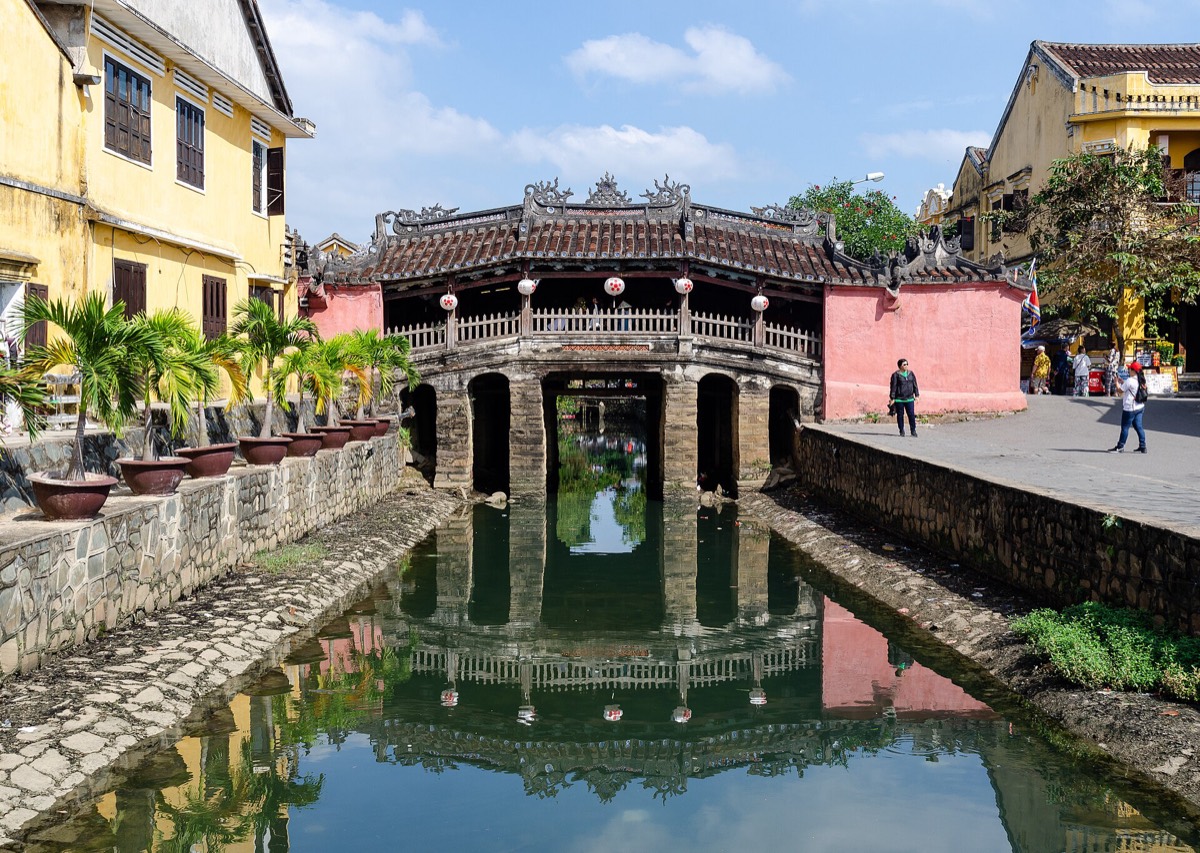
The Japanese Covered Bridge, Chua Cau, is traditionally said to have been built by that Japanese community in the 1590s to link their quarter with the Chinese one. A tiny temple is built into its northern side. Legend says the bridge pins down the back of a monster whose thrashing caused earthquakes as far away as Japan. A careful restoration was completed in 2024, and the bridge appears on the 20,000 dong banknote.
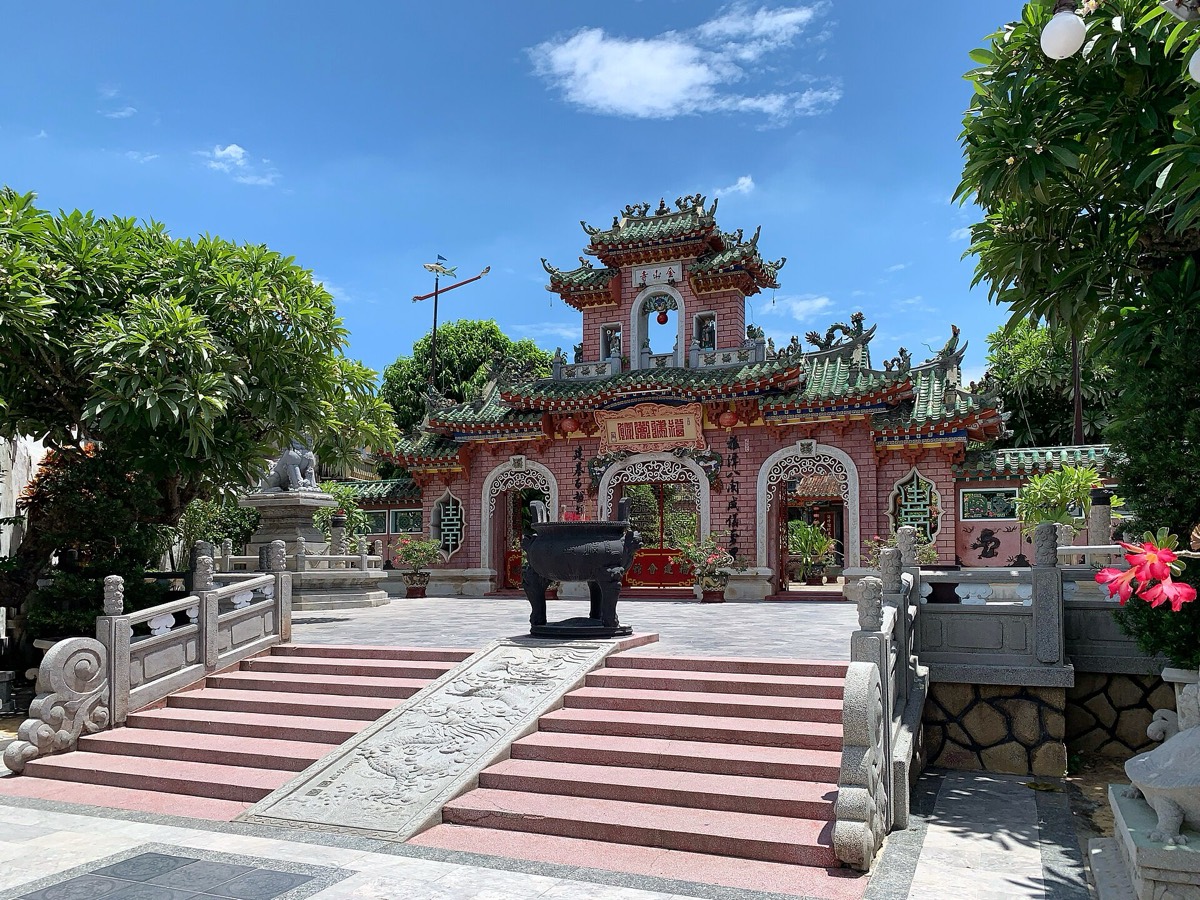
When Japan closed its borders in the 1630s the Japanese community faded, and the Chinese took over. Their assembly halls, built for clans from Fujian, Guangdong, Chaozhou and Hainan, are the most ornate buildings in town: dragons made of broken porcelain, coils of incense hanging from the ceiling for weeks, and model ships for the sea goddess Thien Hau, protector of sailors.
The merchant houses tell the same story in wood. Tan Ky and Phung Hung houses, both still lived in by descendants of the original families, mix Japanese roof beams, Chinese carving and Vietnamese layout. Look for the high marks on the walls: they record the floods that still fill the ground floors almost every autumn.

Getting there
Hoi An is about 30 km south of Da Nang airport, roughly 40–50 minutes by taxi or ride-hailing car. Inside the old town, cars and most motorbikes are restricted for much of the day, so walk or cycle; many guesthouses lend bicycles for free.
Tickets are sold at booths on the edge of the old town. The system has changed several times, and recently the ticket has been checked mainly at entry points and at the heritage sites rather than on every street, so keep it with you all day.
A suggested plan
- 6:00Walk along Bach Dang by the river while the market boats unload and the mist lifts.
- 7:30Breakfast of banh mi or mi Quang, then the Japanese Bridge before the crowds.
- 9:00Phuc Kien (Fujian) assembly hall and the Quan Cong temple on Tran Phu street.
- 10:30Tan Ky or Phung Hung house; ask a family member to show you the flood marks.
- MiddayRest through the heat; Hoi An lanes are hot and shadeless after 11:00.
- 16:00Cross to An Hoi island and watch the town turn gold from the far bank.
Where to stay
Stay within walking or cycling distance of the old town: the streets around Cam Pho and the rice fields toward Cam Thanh are quieter than the centre and only ten minutes by bicycle. Staying in the middle of the old town is atmospheric but noisy in the evening.
Good to know
- Buy water and snacks outside the old town; prices inside are higher.
- Many houses close for lunch; plan heritage visits for the morning.
- A bicycle bell and a slow pace are all you need; the lanes are flat.
- Look up: the best carving is on eaves and beams, not at eye level.
- Motorbikes still pass through some lanes at certain hours; keep to the side.
- Midday heat from May to August is fierce, so carry water and a hat.
- In October and November parts of the old town can flood; check the forecast and local news.