Merdeka Square and the birth of a nation
A green lawn ringed by Moorish arches, a mock-Tudor club and a towering flagpole, where Malaya’s flag first rose at independence in 1957.

- Area
- Old KL
- Start from
- Central Kuala Lumpur
- Distance
- walking distance, about 2 km loop
- Time needed
- half a day
- Best season
- All year; early morning or late afternoon
- Difficulty
- Easy
- Transport
- LRT to Masjid Jamek station
- Tickets & rules
- None; small fees for some museums
Why go
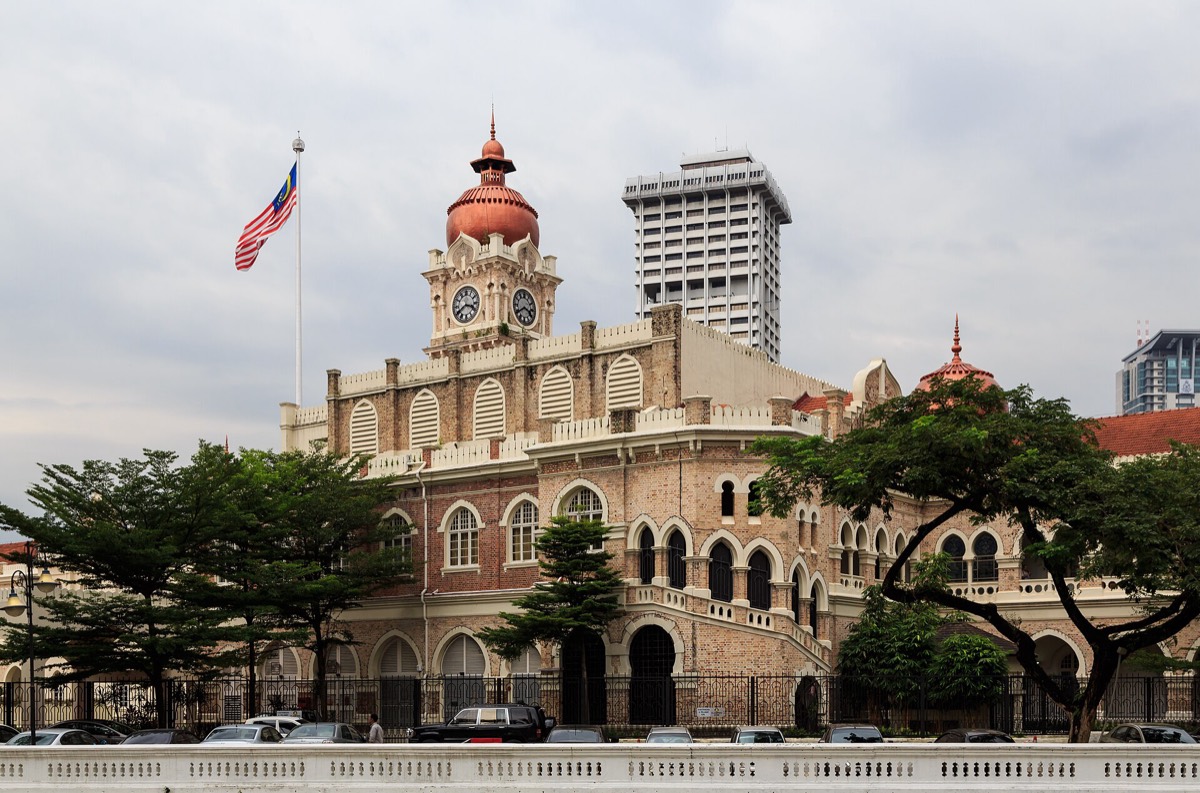
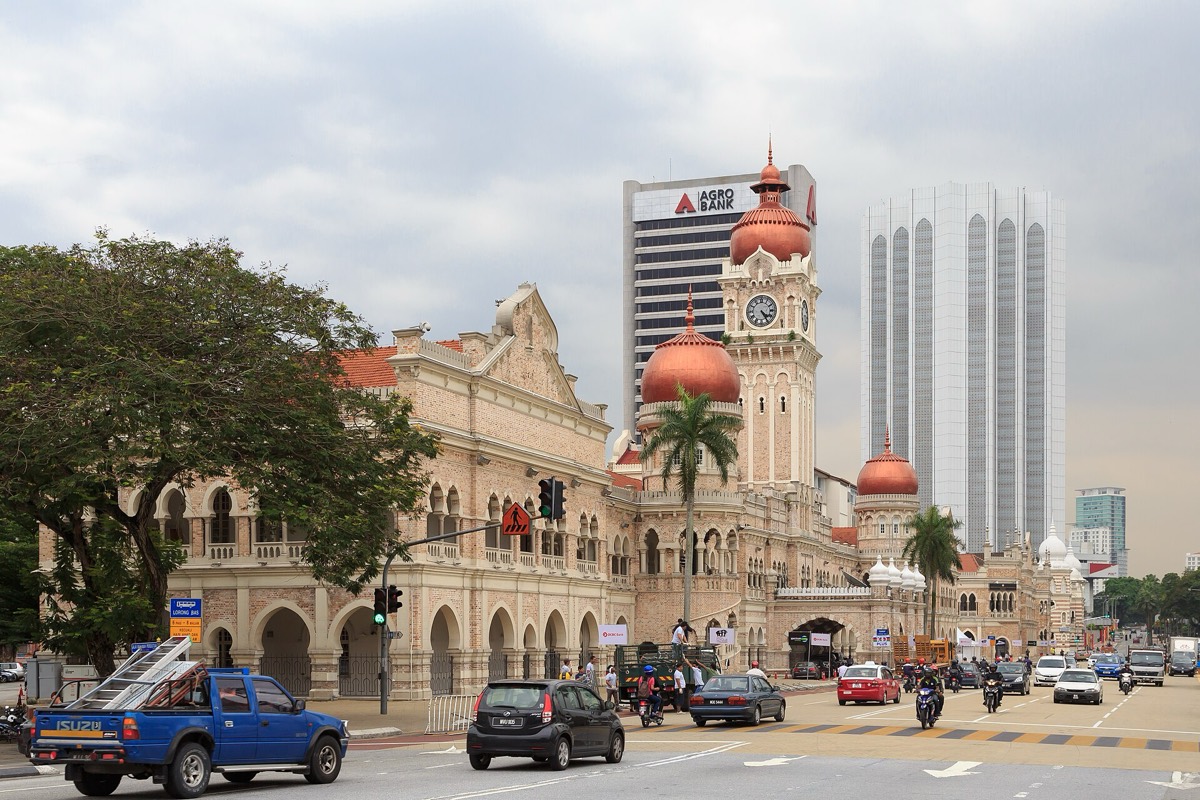
Merdeka Square, Dataran Merdeka in Malay, is the best place to understand how Kuala Lumpur came to look the way it does. On one side of the wide lawn stands the Sultan Abdul Samad Building, all copper domes, horseshoe arches and a 40-metre clock tower, built in a style the British called ‘Indo-Saracenic’. On the other side, as if from a different country, sits the black-and-white Royal Selangor Club, half-timbered like an English pub.
The lawn itself was once the padang, the cricket field of colonial KL, and it still feels like a stage. Early in the morning you share it with joggers and a few photographers; on the weekend before 31 August it fills with rehearsals for the National Day parade.
It’s also a pleasant walk. Within a few hundred metres you have a neo-Gothic cathedral, a textile museum in a striped brick building, the city gallery with its giant scale model of KL, and the river confluence where the city began.
The story
At midnight on 31 August 1957 the Union Jack was lowered here and the flag of the new Federation of Malaya was raised, while the formal proclamation of independence was read by Tunku Abdul Rahman the next morning at the nearby Merdeka Stadium. The flagpole at the southern end of the square, about 95 metres tall, marks the spot and was for years among the tallest in the world.
The Sultan Abdul Samad Building was completed in 1897 to house the colonial government offices, designed by A.C. Norman with later input from other architects of the Public Works Department. They borrowed freely from Mughal India and Moorish Spain, inventing a ‘Muslim’ look for a Malay state that had never had buildings like it, and the style spread across the city.
The Royal Selangor Club, founded in 1884, was the social heart of colonial life and was nicknamed ‘the Spotted Dog’, possibly after a dalmatian belonging to an early member’s wife. One small piece of history began in its annex: in 1938 a group of British expatriates started running through the city after a paper trail every Monday, and the club’s mess, known as the ‘Hash House’, gave its name to the Hash House Harriers, now a running club with chapters around the world.
St Mary’s Cathedral, at the north end, dates from 1894 and has a pipe organ said to be built by the famous English firm of Henry Willis.

Getting there
Take the LRT to Masjid Jamek station, the interchange of two lines, and walk five minutes west across the river. From Chinatown it’s a ten-minute walk north. The free GoKL city buses also stop nearby.
A suggested plan
- 8:00Walk the lawn and photograph the Sultan Abdul Samad Building in the soft early light.
- 9:00Visit the KL City Gallery for the scale model and the ‘I love KL’ sign photo.
- 10:00Explore the National Textile Museum: batik, songket and Peranakan beadwork.
- 11:30Walk to the river confluence and Masjid Jamek, then down to Central Market for lunch.
- EveningCome back at dusk, when the old buildings are lit up and the square cools.
Where to stay
Chinatown, ten minutes’ walk away, has heritage guesthouses and boutique hotels in old shophouses, perfect for exploring the old centre on foot.
Good to know
- The square is beautifully lit after dark and much cooler than at midday.
- The City Gallery’s model of Kuala Lumpur is surprisingly helpful for orientation on day one.
- Look for the small plaque marking the founding of the Hash House Harriers near the club.
- Public toilets and cool air are in the underground Plaza Dataran Merdeka.
- The square has very little shade; in midday sun wear a hat and carry water.
- Parts of the area are closed off during national celebrations and rehearsals in August.