Hue: royal tombs and Thien Mu pagoda
A day upriver from Hue, visiting a pagoda on a hill, and the tombs of emperors set among lakes, pine forests and frangipani trees.

- Area
- Hue
- Start from
- Hue
- Distance
- about 20–30 km loop
- Time needed
- 1 day
- Best season
- February – August
- Difficulty
- Easy
- Transport
- Bicycle, scooter, car or a boat on the Perfume River
- Tickets & rules
- Tickets for each tomb, or a combination ticket; dress modestly
Why go
The Nguyen emperors spent years planning their tombs, and each tomb reflects the emperor’s personality. They lie in the hills south of Hue along the Perfume River, among forests and lakes, and each feels like a small park.
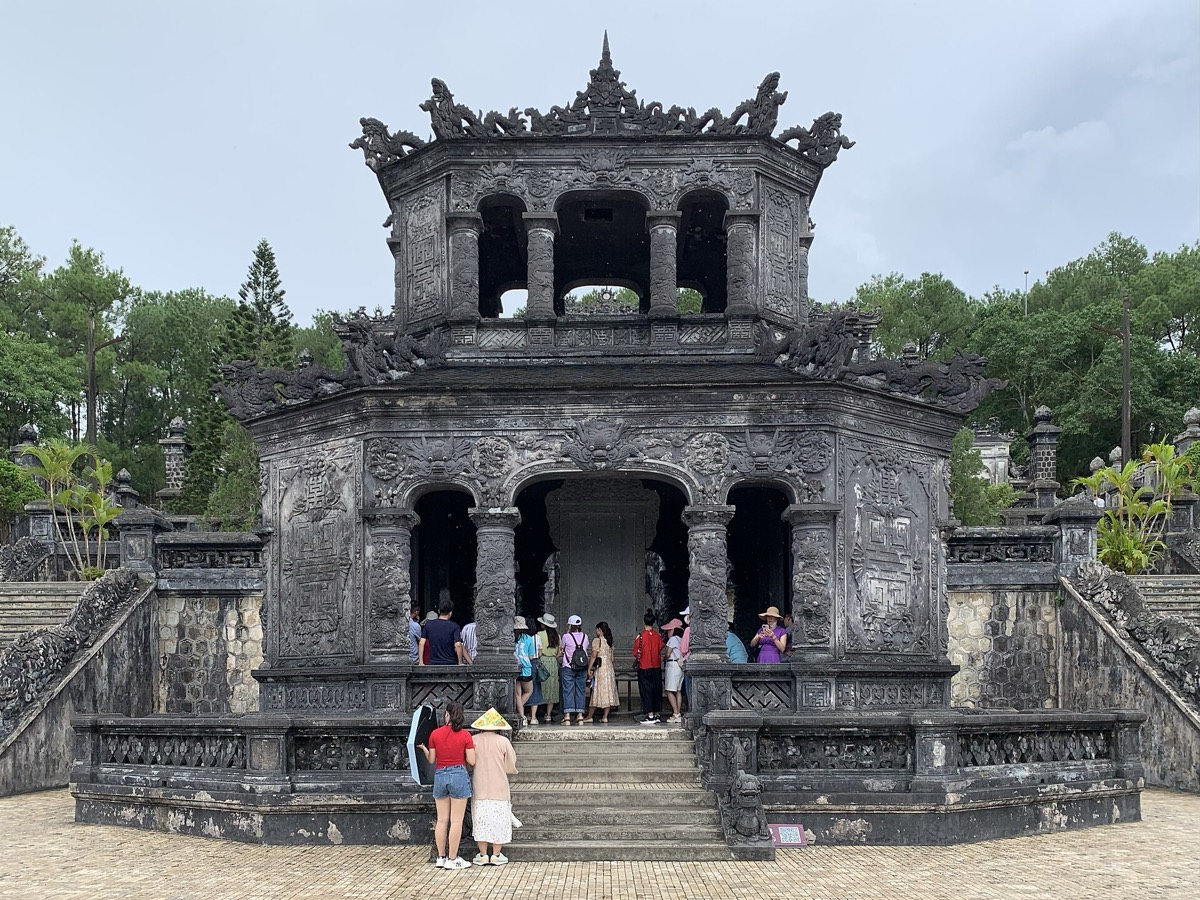
Tu Duc’s tomb is romantic, with a lake, pavilions and frangipani trees; the emperor used it as a retreat while he was still alive. Minh Mang’s tomb is formal and symmetrical, a sequence of gates, courtyards and bridges. Khai Dinh’s tomb, built later, is a strange fusion of European and Vietnamese styles, made of concrete and decorated inside with ceramic and glass mosaics.
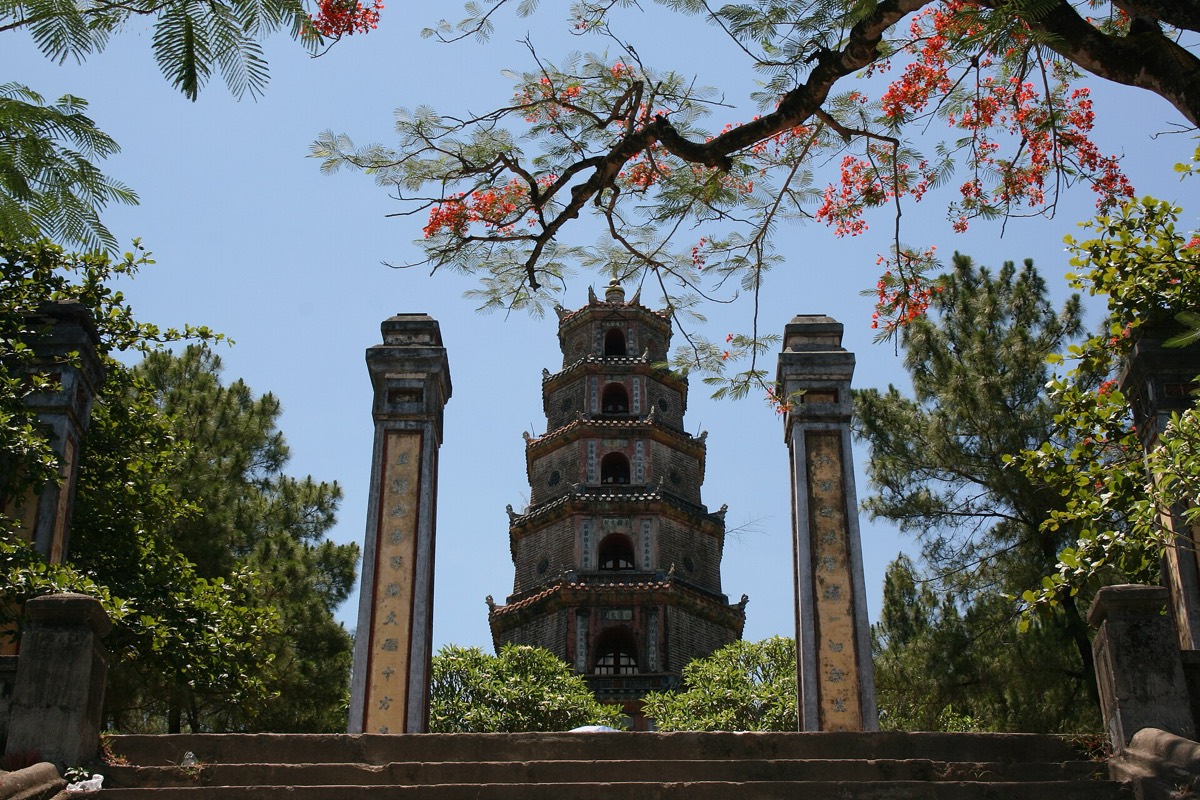
On the way, stop at Thien Mu pagoda, with its seven-storey tower overlooking the river. It is one of the most beloved symbols of Hue.
The story
Thien Mu pagoda was founded in 1601 by Nguyen Hoang, the lord who first ruled the region. A legend says an old woman appeared on the hill and told people that a lord would build a pagoda there. Its tower, Phuoc Duyen, was built in 1844.
Tu Duc reigned from 1847 to 1883, the longest of any Nguyen emperor. His tomb was built between 1864 and 1867, and he wrote poetry there. Legend says he was not buried in the tomb; his real burial place remains secret.
Minh Mang, Gia Long’s son, was a strong ruler. His tomb was completed after his death in 1841 and is considered one of the most harmonious in architecture.
Khai Dinh, who reigned from 1916 to 1925, built a tomb that took eleven years to complete, from 1920 to 1931. Its mix of Gothic, Baroque and Vietnamese elements reflects the changing times. Inside, every surface of the main hall is covered in mosaics of broken porcelain and coloured glass, many pieces imported from China and Japan, and a bronze statue of the emperor sits under a heavy concrete canopy made to look like silk.
The Perfume River itself is part of the story. Its name, Song Huong, is often explained by the scent of flowers and herbs that fall into the water upstream in spring. For the emperors, the river was the axis of the whole landscape: palaces, tombs and pagodas were placed in relation to it and to the low hills on either bank according to geomancy, so that each tomb faces water and is protected by a mountain behind.

Getting there
From Hue, cycle or ride to Thien Mu pagoda, about 4 km west, and then continue to the tombs, which are spread over 10–15 km. A car with a driver is easier in the heat.
Dragon boats on the Perfume River also stop at Thien Mu and some tombs.
A suggested plan
- 7:30Thien Mu pagoda in the morning light.
- 9:00Tu Duc’s tomb.
- 11:00Khai Dinh’s tomb.
- LunchA riverside lunch.
- 14:00Minh Mang’s tomb, then back to Hue.
Where to stay
Stay in Hue; this route needs a full day.
Good to know
- Buy a combination ticket.
- Bring water and a hat.
- Visit Khai Dinh early or late to avoid crowds.
- Read about the emperors beforehand.
- Roads can be busy and hot.
- Steps at Khai Dinh are steep.
- Monks live at Thien Mu; be respectful.