Ban Phanom Weavers and Mouhot’s Tomb
A short ride east of town leads to a village of looms and silk, and onwards along the Nam Khan to the lonely grave of a nineteenth-century French explorer.

- Area
- Villages & crafts
- Start from
- Luang Prabang old town
- Distance
- about 4 km by road, plus a riverside walk
- Time needed
- half a day
- Best season
- November – April, dry season
- Difficulty
- Easy
- Transport
- Bicycle, scooter or tuk-tuk
- Tickets & rules
- None
Why go
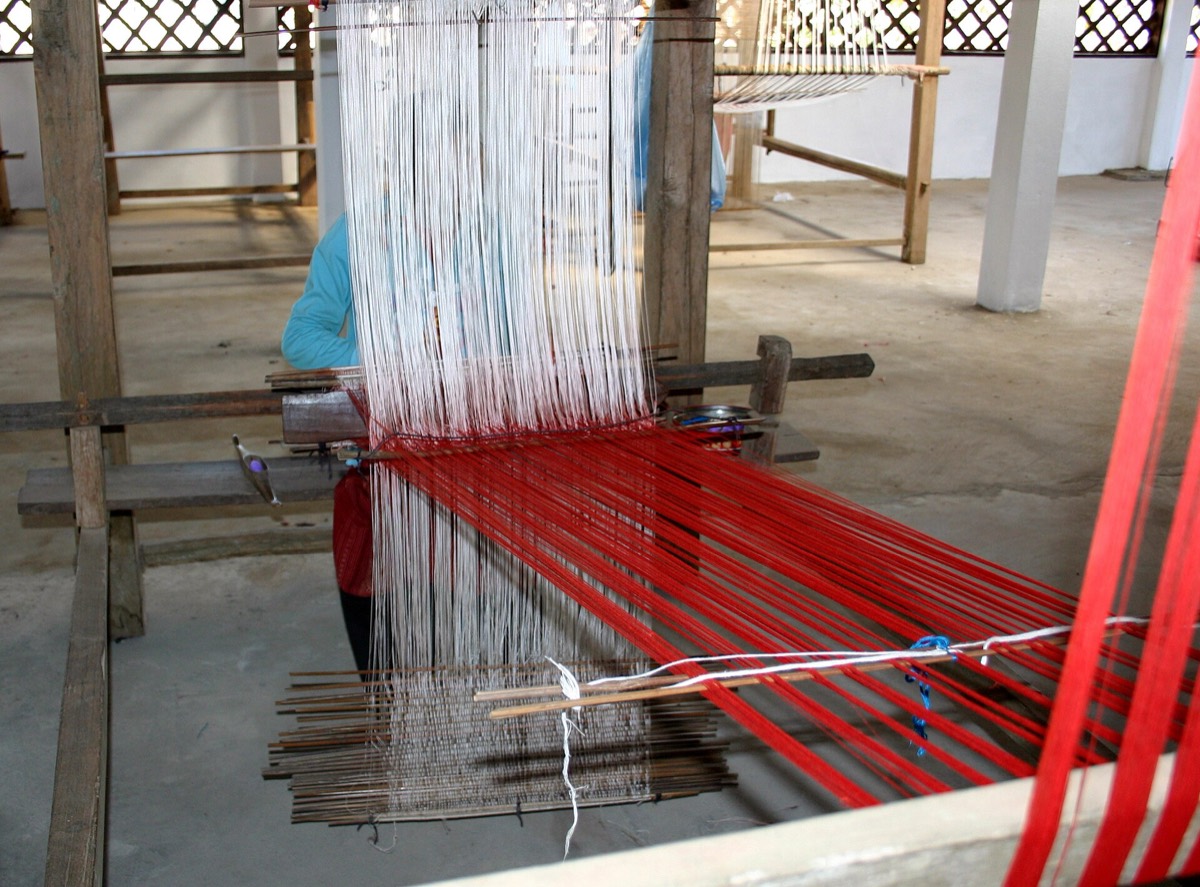
Ban Phanom is where I go when I want to see textiles being made rather than sold. The village is home to a community of Tai Lue weavers, and on a quiet morning you hear the clack of wooden looms from under the stilt houses, where women weave silk and cotton in patterns passed down through generations.
The village has a small market hall where the weavers sell directly, and the prices and quality are often better than in town. Even if you buy nothing, watching the shuttle fly back and forth and the patterns emerge thread by thread is a lesson in patience.
Continue a little further along the river road and you reach the tomb of Henri Mouhot, a French naturalist who died nearby in 1861. It is a peaceful, slightly melancholic place in the trees by the Nam Khan, and the ride there is lovely.
The story
The Tai Lue are a Tai-speaking people whose homeland is in Sipsongpanna, in what is now southern Yunnan. Over centuries, groups migrated south into Laos, Thailand and Myanmar, bringing a strong weaving tradition with them. Ban Phanom’s families are said to have once woven for the royal court of Luang Prabang.
Their cloth is distinctive: skirts called sinh with complex supplementary-weft patterns, often in deep reds, indigo and gold, decorated with motifs of nagas, birds, diamonds and stylised trees. A finely woven sinh can take weeks of work, and many Lao women still wear them for temple visits and ceremonies.
Henri Mouhot is best known for his descriptions of Angkor in Cambodia, which brought the temples to wide European attention in the 1860s. He travelled up the Mekong into Laos and fell ill with fever near Luang Prabang, dying in November 1861. His servants buried him by the river; the simple white tomb that stands there today was built later by the French.
His notes, published after his death, describe the kindness of the people who cared for him and the beauty of the country. The tomb was overgrown and almost forgotten for much of the twentieth century, and today it is marked by a small sign and visited by occasional travellers who make the ride out.
Getting there
Ban Phanom lies a few kilometres east of the old town, past the market and the stadium area. It is an easy bicycle ride on flat roads, or a short tuk-tuk ride. Mouhot’s tomb is a couple of kilometres further, along a riverside track; ask locally for directions.
A scooter makes the trip simpler if you want to continue to other villages.
A suggested plan
- 8:30Cycle out of town towards Ban Phanom.
- 9:00Walk the lanes, watch the weavers and visit the village market hall.
- 10:30Ride on along the Nam Khan to Mouhot’s tomb.
- 11:30Return the same way, stopping for a fruit shake in town.
- AfternoonVisit the ethnology centre in town to see how the textiles you saw fit into wider Lao culture.
Where to stay
Stay in the old town; Ban Phanom is an easy half-day ride.
Good to know
- Ask before photographing weavers at work; most are happy to oblige if you show interest.
- Natural-dye silk costs more than chemical-dye cotton; ask what you are buying.
- Bring cash in kip for purchases.
- Don’t haggle aggressively; prices reflect many hours of work.
- The road out of town carries trucks; ride carefully and wear a helmet on a scooter.